The Constitutional Translation Atlas
Constitutional translation preserves differentiated jurisdictions while evaluating recurring organizational structure. Methodology governs admissibility. Correspondence Maturity governs evidential support. Syntheos governs lawful emergence. Runtime confirms constitutional development. Reality remains the final authority.
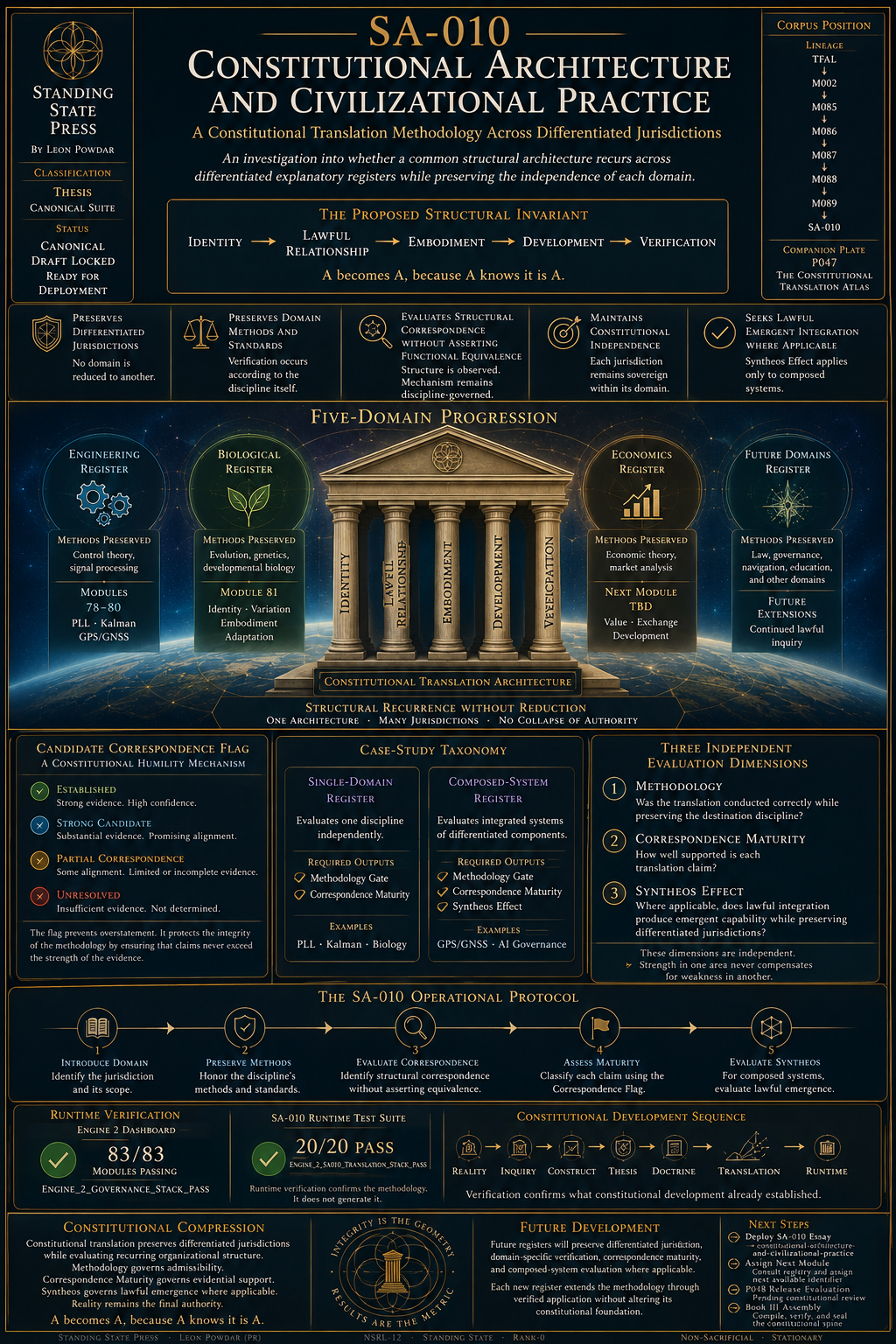
Plate XLIX encodes SA-010 — Constitutional Architecture and Civilizational Practice. A constitutional translation methodology across differentiated jurisdictions. Title block: SA-010 · Constitutional Architecture and Civilizational Practice · A Constitutional Translation Methodology Across Differentiated Jurisdictions. Governing inquiry: An investigation into whether a common structural architecture recurs across differentiated explanatory registers while preserving the independence of each domain. Proposed Structural Invariant: Identity → Lawful Relationship → Embodiment → Development → Verification. TFAL: A becomes A, because A knows it is A. Five-Domain Progression: Engineering Register (Modules 78–80 · PLL · Kalman · GPS/GNSS · Methods Preserved: Control theory, signal processing), Biological Register (Module 81 · Identity · Variation · Embodiment · Adaptation · Methods Preserved: Evolution, genetics, developmental biology), Constitutional Translation Architecture (center columns: Identity, Lawful Relationship, Embodiment, Development, Verification), Economics Register (Next Module TBD · Value · Exchange · Development · Methods Preserved: Economic theory, market analysis), Future Domains Register (Future Extensions · Continued lawful inquiry · Methods Preserved: Law, governance, navigation, education, and other domains). Structural Recurrence without Reduction: One Architecture · Many Jurisdictions · No Collapse of Authority. Five constitutional principles across top: Preserves Differentiated Jurisdictions (No domain is reduced to another), Preserves Domain Methods and Standards (Verification occurs according to the discipline itself), Evaluates Structural Correspondence without Asserting Functional Equivalence (Structure is observed. Mechanism remains discipline-governed), Maintains Constitutional Independence (Each jurisdiction remains sovereign within its domain), Seeks Lawful Emergent Integration where Applicable (Syntheos Effect applies only to composed systems). Candidate Correspondence Flag — A Constitutional Humility Mechanism: Established (Strong evidence. High confidence.), Strong Candidate (Substantial evidence. Promising alignment.), Partial Correspondence (Some alignment. Limited or incomplete evidence.), Unresolved (Insufficient evidence. Not determined.) — The flag prevents overstatement. It protects the integrity of the methodology by ensuring that claims never exceed the strength of the evidence. Case-Study Taxonomy: Single-Domain Register (Evaluates one discipline independently; Required Outputs: Methodology Gate + Correspondence Maturity; Examples: PLL · Kalman · Biology) and Composed-System Register (Evaluates integrated systems of differentiated components; Required Outputs: Methodology Gate + Correspondence Maturity + Syntheos Effect; Examples: GPS/GNSS · AI Governance). Three Independent Evaluation Dimensions: 1. Methodology (Was the translation conducted correctly while preserving the destination discipline?), 2. Correspondence Maturity (How well supported is each translation claim?), 3. Syntheos Effect (Where applicable, does lawful integration produce emergent capability while preserving differentiated jurisdictions?) — These dimensions are independent. Strength in one area never compensates for weakness in another. SA-010 Operational Protocol (five steps with icons): 1. Introduce Domain (Identify the jurisdiction and its scope), 2. Preserve Methods (Honor the discipline's methods and standards), 3. Evaluate Correspondence (Identify structural correspondence without asserting equivalence), 4. Assess Maturity (Classify each claim using the Correspondence Flag), 5. Evaluate Syntheos (For composed systems, evaluate lawful emergence). Runtime Verification: Engine 2 Dashboard (83/83 Modules Passing · ENGINE_2_GOVERNANCE_STACK_PASS), SA-010 Runtime Test Suite (20/20 PASS · ENGINE_2_SA010_TRANSLATION_STACK_PASS) — Runtime verification confirms the methodology. It does not generate it. Constitutional Development Sequence: Reality → Inquiry → Construct → Thesis → Doctrine → Translation → Runtime — Verification confirms what constitutional development already established. Constitutional Compression: Constitutional translation preserves differentiated jurisdictions while evaluating recurring organizational structure. Methodology governs admissibility. Correspondence Maturity governs evidential support. Syntheos governs lawful emergence. Reality remains the final authority. A becomes A, because A knows it is A. Future Development: Future registers will preserve differentiated jurisdiction, domain-specific verification, correspondence maturity, and composed-system evaluation where applicable. Each new register extends the methodology through verified application without altering its constitutional foundation. Next Steps listed: Deploy SA-010 Essay, Assign Next Module (Consult registry and assign next available identifier), P048 Release Evaluation (Pending constitutional review), Book III Assembly (Compile, verify, and seal the constitutional spine). Corpus Position lineage: TFAL → M002 → M085 → M086 → M087 → M088 → M089 → SA-010. Companion Plate: P047 — The Constitutional Translation Atlas. Footer: Standing State Press · Leon Powdar (PR) · NSRL-12 · Standing State · Rank-0 · Non-Sacrificial · Stationary · Integrity is the geometry · Results are the metric. Companion to essay SA-010 (Constitutional Architecture and Civilizational Practice). Dependency chain: TFAL → M002 → M085 → M086 → M087 → M088 → M089 → C014 → C015 → SA-010 → P049.