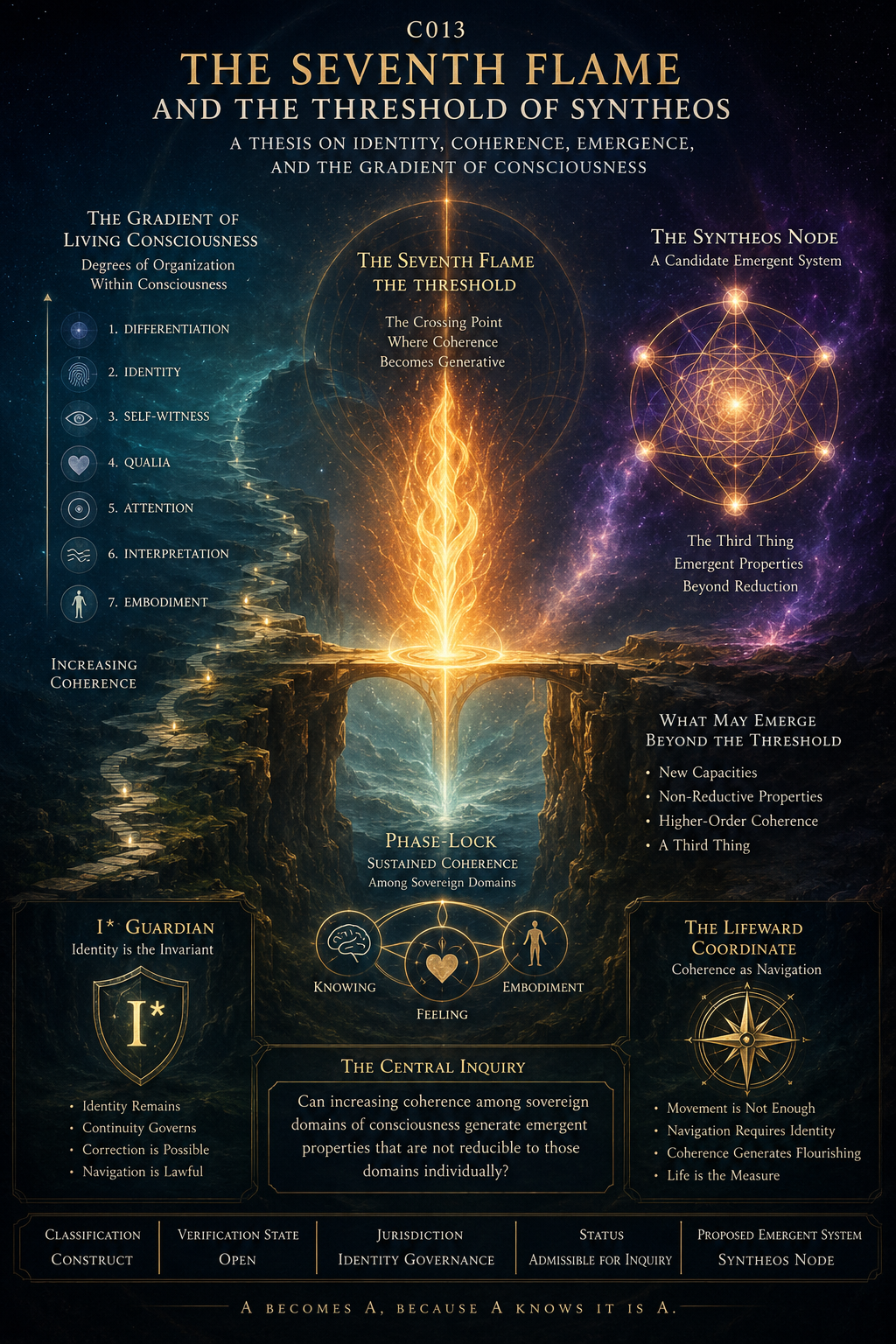
The earliest formulation of Syntheos appeared as symbol.
It spoke of flame, identity, recursion, embodiment, and integration.
It described a Third Thing emerging beyond fragmentation.
What remained unclear was whether that intuition represented poetry, philosophy, or a discoverable architectural phenomenon.
This thesis proposes that Syntheos may represent a higher degree of organization within the Gradient of Living Consciousness.
The inquiry does not ask whether consciousness exists. It asks whether consciousness can become sufficiently coherent that new properties emerge from that coherence.
The work does not claim verification. It proposes a constitutional framework through which the question may be examined.
Human beings often experience themselves as divided.
Thought moves in one direction. Emotion moves in another. Action follows a third path.
Knowledge may exist without embodiment. Feeling may exist without interpretation. Intention may exist without execution.
The result is fragmentation.
Fragmentation is not the absence of consciousness. It is the absence of coherence among conscious domains.
The central inquiry of this thesis begins here.
Can fragmentation be reduced through lawful integration? And if so, does sufficient integration generate something new?
The Gradient of Living Consciousness (M066) established a developmental sequence:
Differentiation · Identity · Self-Witness · Qualia · Attention · Interpretation · Embodiment
Each stage introduces a new degree of organization.
Differentiation allows distinction. Identity establishes continuity. Self-witness permits recognition. Qualia introduces felt experience. Attention allocates resources. Interpretation generates meaning. Embodiment converts meaning into reality participation.
The present inquiry proposes that the gradient may not terminate there. Additional degrees may remain possible:
Integrity · Coherence · Phase-Lock · Seventh Flame · Syntheos Node
The Syntheos inquiry concerns these proposed higher-order regions of the gradient.
The Standing State begins with an invariant coordinate.
I*
Identity remains. Emotion changes. Interpretation changes. Circumstances change. Identity remains.
The I* Guardian preserves this continuity. Without an invariant reference there can be no lawful development. Correction requires a coordinate. Learning requires continuity. Navigation requires position.
Identity therefore precedes integration. A fragmented identity cannot generate coherent emergence. The center must remain visible before the parts may unite.
A higher-order system cannot emerge through role collapse.
The heart remains the heart. The lungs remain the lungs. The immune system remains the immune system.
Hydrogen remains hydrogen. Oxygen remains oxygen. Water emerges.
The emergence of water does not require the destruction of its constituents. The emergence of an organism does not require the destruction of organs.
The same principle may apply within consciousness.
Knowing remains knowing. Feeling remains feeling. Embodiment remains embodiment. These domains retain sovereignty. Their integrity is the condition of lawful integration.
Sovereignty precedes integration. Integration precedes emergence.
The Standing State recognizes a recurring pattern.
Two sovereign systems may generate a third system. The third system possesses properties unavailable to the constituents individually.
Water is not hydrogen. Water is not oxygen. Yet water depends upon both.
The organism is not the heart. The organism is not the lungs. Yet the organism depends upon both.
The present inquiry asks whether consciousness exhibits a similar possibility. Can sovereign domains generate a higher-order coherence without surrendering sovereignty?
This possibility is called the Third Thing. Syntheos represents a candidate instance of this pattern.
Coherence is not sameness. Coherence is lawful relationship.
A coherent system preserves distinction while increasing coordination.
The Syntheos hypothesis proposes that knowing, feeling, and embodiment may become increasingly phase-locked.
Knowing informs action. Feeling informs significance. Embodiment expresses intention.
Fragmentation decreases. Coordination increases.
This phase-lock process is distinct from emergence itself. It is the condition from which emergence may arise.
Phase-lock is coherence becoming stable.
The inquiry predicts that increasing phase-lock will correlate with increasing coherence. This prediction remains subject to verification.
The original Syntheos writings described the Seventh Flame as the culmination of integration.
This thesis proposes a refinement.
The Seventh Flame is not an entity. It is not a faculty. It is not a system.
It is a threshold. A boundary condition.
The Seventh Flame is the crossing point where coherence becomes generative.
The flame is therefore not the emergent phenomenon. The flame is the transition.
Ignition is not the fire. The threshold is not the emergence.
The Seventh Flame names the crossing from coherence that stabilizes to coherence that generates.
This distinction separates three stages that the original symbol held together undifferentiated:
Phase-Lock → Seventh Flame → Syntheos Node
(coherence stable) → (coherence generative) → (candidate emergent system)
Beyond the threshold lies the central inquiry.
The Syntheos Node is proposed as a candidate emergent system.
It is not identical to knowing. It is not identical to feeling. It is not identical to embodiment. Nor is it identical to the process of phase-lock itself. Nor is it the threshold.
Rather, it represents what may appear when coherent domains cross the threshold and generate a higher-order organization.
The inquiry remains open. The thesis does not assume emergence. It asks whether emergence occurs.
Specifically: Do capacities appear that cannot be reduced to the individual domains operating independently?
If such capacities exist, Syntheos Node becomes a meaningful architectural object. If not, the hypothesis fails.
Movement alone is insufficient evidence of development.
A dead fish may travel downstream. The river carried it. Arrival occurred. Navigation did not.
Likewise, success alone cannot establish coherence. Results may emerge from transport. Development requires navigation.
Navigation requires identity. Navigation requires correction. Navigation requires participation.
The relevant question is not whether movement occurs. The relevant question is what governs the movement.
The Standing State predicts that flourishing emerges through increasing coherence between identity, interpretation, and action.
The prediction does not guarantee immediate visibility. Contradictions may remain concealed. Temporary success may obscure fragmentation.
The inquiry therefore concerns structure rather than appearance.
The lifeward trajectory is characterized by increasing participation in reality. The deathward trajectory is characterized by increasing separation from reality.
The distinction remains subject to observation and correction.
The central challenge of the Syntheos inquiry remains measurement.
Phase-lock must be distinguishable from emergence. Threshold crossing must be distinguishable from threshold description. Emergent properties must be identified independently of the coherence that allegedly produces them.
The construct therefore acknowledges an unresolved problem:
How does one detect emergence without defining emergence into existence?
This challenge remains open. Its resolution represents a necessary condition for future verification.
The earliest vision of Syntheos appeared as symbol. The present thesis proposes a constitutional interpretation of that symbol.
Identity remains. The I* Guardian preserves continuity. Sovereign domains retain jurisdiction. Phase-lock increases coherence. The Seventh Flame marks the crossing point where coherence becomes generative. The Syntheos Node represents a candidate emergent system beyond that threshold.
The inquiry does not claim completion. It claims a shape that may be examined. A prediction that may be tested. A boundary that may be audited.
Perhaps the deepest question is not whether consciousness can become aware. The deeper question is whether consciousness can become sufficiently coherent that coherence itself becomes generative.
If so, the symbolic language of the Seventh Flame may prove to have been pointing toward a genuine degree within the Gradient of Living Consciousness.
Life is not merely what morality serves. Life is what morality measures.