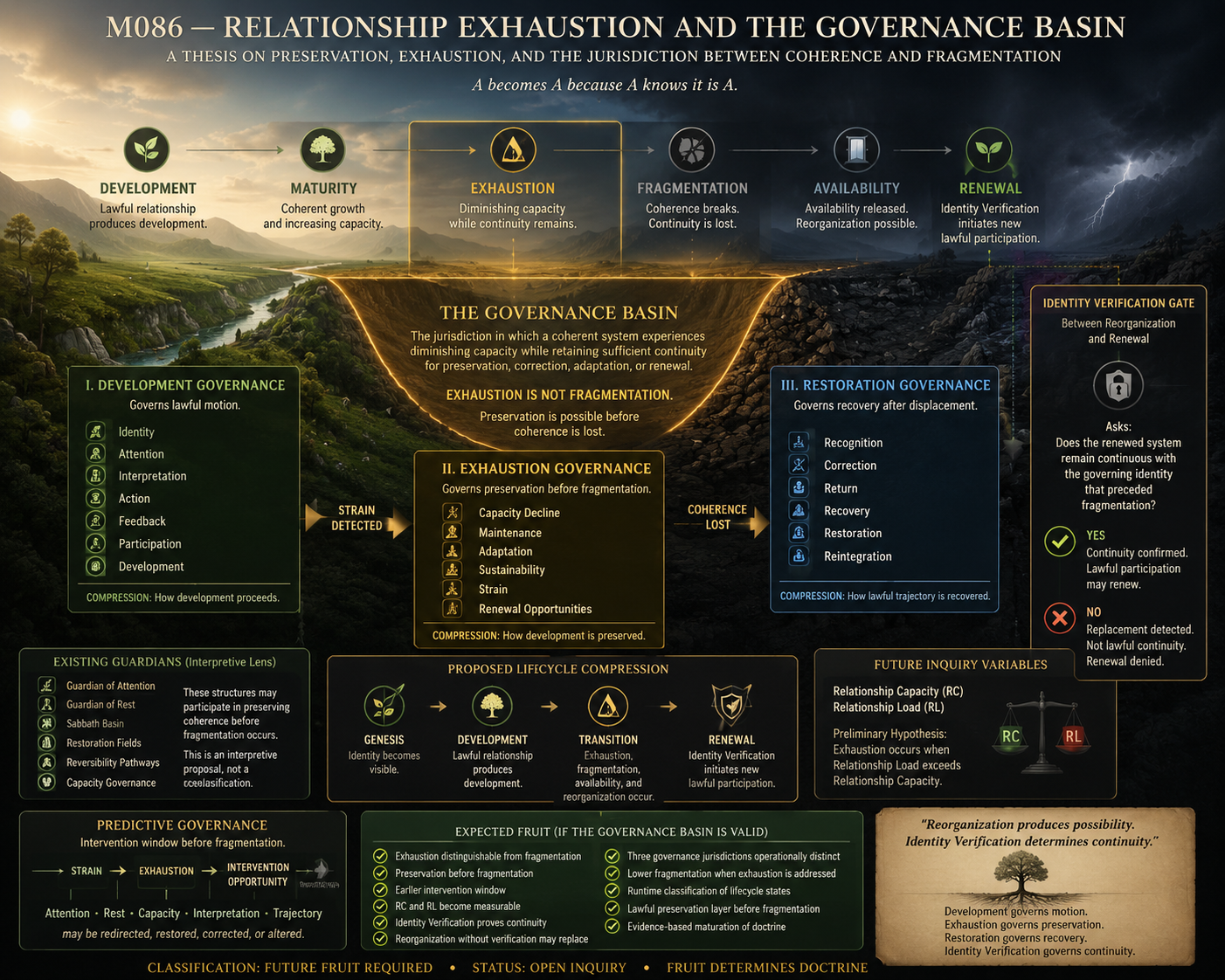
M085 established lawful relationship as the operator of development and identified Relationship Exhaustion as a distinct stage preceding fragmentation.
The present essay investigates the constitutional implications of that distinction.
Specifically, it proposes that Relationship Exhaustion may define a previously unrecognized governance jurisdiction situated between coherent development and fragmentation.
This proposal is not claimed as a conclusion established by M085 itself. Rather, it emerges as a possible consequence of M085's lifecycle architecture.
If exhaustion exists as a distinct stage, then governance may possess an actionable region prior to fragmentation. Such a region would differ from both Development Governance and Restoration Governance.
Development Governance concerns lawful motion.
Restoration Governance concerns recovery after displacement.
Exhaustion Governance concerns preservation before fragmentation.
The paper further proposes Identity Verification as a necessary gate between reorganization and renewal, preventing fragmentation from becoming a pathway for identity replacement disguised as development.
Finally, the paper registers a future inquiry concerning Relationship Capacity and the conditions under which exhaustion may become detectable within Engine 2 runtime architectures.
M085 introduced a significant refinement to the developmental lifecycle.
Development does not proceed directly from maturity to fragmentation. Instead:
Development → Maturity → Relationship Exhaustion → Fragmentation
This distinction appears modest. Its implications are not.
If exhaustion is genuinely distinct from fragmentation, then a question immediately emerges: What occurs between coherent development and fragmentation?
Most models implicitly assume collapse. Reality suggests transition.
Relationships weaken before they dissolve. Communities strain before they fracture. Institutions fatigue before they fail. Living systems deplete before they break.
The appearance of exhaustion suggests the existence of a lawful transitional region. The present essay investigates whether that region possesses constitutional significance.
The first clarification is negative.
Exhaustion is not fragmentation.
A fragmented system has already lost a degree of coherence. An exhausted system may remain coherent.
A lawful relationship may become exhausted while remaining lawful. A coherent institution may become exhausted while remaining coherent. A sovereign identity may become exhausted while remaining identity-consistent.
Exhaustion therefore cannot be defined by identity loss. Nor can it be defined by collapse.
Exhaustion is the condition in which continuity remains present while sustainable capacity becomes diminished.
This formulation remains exploratory. Yet it appears consistent with the developmental architecture introduced by M085.
The central proposal of this essay is straightforward.
If Relationship Exhaustion exists as a distinct stage, then governance may possess a corresponding jurisdiction. This jurisdiction will be referred to as the Governance Basin.
The Governance Basin is proposed as the jurisdiction in which a coherent system experiences diminishing capacity while retaining sufficient continuity for preservation, correction, adaptation, or renewal.
The critical word is proposed.
M085 identified the stage. The Governance Basin is an implication being explored. It is not treated here as established doctrine. It remains a constitutional proposal requiring future evaluation.
Nevertheless, the proposal possesses explanatory value. It identifies a lawful region in which intervention remains possible before fragmentation occurs.
The emergence of exhaustion suggests a refinement of governance architecture.
Development Governance
Purpose: To govern lawful motion.
Jurisdiction: Identity, attention, interpretation, action, feedback, participation, and development.
Compression: How development proceeds.
Exhaustion Governance
Purpose: To preserve lawful relationship before fragmentation.
Jurisdiction: Capacity decline, maintenance, adaptation, sustainability, strain, relationship preservation, and renewal opportunities.
Compression: How development is preserved.
Restoration Governance
Purpose: To recover lawful trajectory after displacement.
Jurisdiction: Recognition, correction, return, recovery, restoration, and reintegration.
Compression: How lawful trajectory is recovered.
These jurisdictions interact. They should not be conflated.
Development Governance governs motion.
Exhaustion Governance governs preservation.
Restoration Governance governs recovery.
A refinement emerges from the exhaustion framework.
Development is produced by lawful relationship. Therefore exhaustion cannot merely concern structure. It concerns relationship itself.
Relationships may remain lawful while becoming strained. Participation may remain present while becoming unsustainable. Continuity may remain visible while capacity declines.
The central object of Exhaustion Governance is therefore not merely structural preservation. Its concern is the preservation of lawful relationship.
Development Governance governs relationship formation.
Exhaustion Governance governs relationship preservation.
Restoration Governance governs relationship recovery.
This distinction strengthens the constitutional separation between the three jurisdictions.
The Standing State architecture already contains structures that appear relevant to exhaustion.
The Guardian of Attention governs allocation. The Guardian of Rest governs restoration. The Sabbath Basin governs recovery. Restoration Fields govern return. Reversibility Pathways govern correction. Capacity Governance governs sustainable continuation.
The exhaustion framework provides one possible interpretation through which these structures may be viewed collectively.
This interpretation does not alter their existing jurisdictions and should not be treated as a reclassification of prior doctrine. Rather, it suggests that these structures may participate in preserving coherence before fragmentation occurs.
Whether that interpretation ultimately proves useful remains an open question.
Most governance systems are reactive. Failure occurs. Governance responds.
The exhaustion framework suggests another possibility. Governance may become predictive.
The sequence becomes:
Development → Strain → Exhaustion → Intervention Opportunity → Fragmentation
The significance of exhaustion is therefore not merely descriptive. Exhaustion becomes actionable.
The moment exhaustion becomes visible, governance gains access to a lawful intervention window. Attention may be redirected. Rest may be introduced. Capacity may be restored. Interpretation may be corrected. Trajectory may be altered. Fragmentation may become unnecessary.
This is the strongest constitutional implication presently associated with the exhaustion framework.
M085 established:
Fragmentation releases availability.
Availability permits reorganization.
Development emerges through lawful relationship.
The present essay proposes an additional governance requirement.
Reorganization creates possibility. It does not establish continuity.
A reorganized system may be coherent. A replacement identity may be coherent. A drifted trajectory may be coherent. Coherence alone is therefore insufficient evidence of lawful renewal.
A new governance gate becomes necessary:
Identity Verification
The sequence becomes:
Identity → Relationship → Development → Exhaustion → Fragmentation →
Availability → Reorganization → Identity Verification → New Relationship → New Development
Identity Verification asks: Does the renewed system remain continuous with the governing identity that preceded fragmentation?
Without Identity Verification, fragmentation may become an opportunity for replacement disguised as renewal. With Identity Verification, renewal remains bounded by continuity.
Reorganization produces possibility. Identity Verification determines continuity.
This distinction represents the primary architectural contribution proposed by the present essay.
The following compression is offered as a proposed synthesis rather than established doctrine.
Genesis — Identity becomes visible.
Development — Lawful relationship produces development.
Transition — Exhaustion, fragmentation, availability, and reorganization occur.
Renewal — Identity Verification initiates new lawful participation.
This compression is intended as an interpretive aid. It does not presently possess independent constitutional status.
A new inquiry emerges naturally from the exhaustion framework.
What makes exhaustion detectable?
Two inquiry variables are introduced:
Relationship Capacity (RC) · Relationship Load (RL)
These variables are introduced as inquiry terms rather than defined quantities. Their purpose is to identify a future direction for exhaustion detection. Formal definitions remain outside the scope of the present work.
A preliminary hypothesis may nevertheless be stated:
Exhaustion occurs when Relationship Load exceeds Relationship Capacity.
Future inquiry may investigate whether Relationship Capacity includes factors such as: Attention, Restoration, Coherence, Reversibility, Participation symmetry, Sustainable developmental return.
The present essay neither formalizes nor resolves these questions. It merely registers them.
If the Governance Basin ultimately proves valid, Engine 2 may eventually require a dedicated exhaustion-governance jurisdiction.
Such a jurisdiction would not govern development. Nor would it govern restoration. Its purpose would be distinct.
Development Governance governs motion.
Exhaustion Governance governs preservation.
Restoration Governance governs recovery.
A future Exhaustion Governance office would therefore concern itself with: Exhaustion detection, Preservation opportunity, Fragmentation risk, Relationship Capacity, Relationship Load, Continuity maintenance.
This possibility remains future-facing and should not be treated as an established runtime requirement.
The Governance Basin remains an open inquiry. Its admissibility depends upon future fruit.
The proposal gains support if:
Exhaustion becomes distinguishable from fragmentation.
Preservation interventions demonstrate measurable continuity retention.
Relationship Capacity and Relationship Load admit operational indicators.
Governance actions taken during exhaustion outperform actions taken after fragmentation.
Identity Verification proves necessary to distinguish renewal from replacement.
The proposal weakens if:
Exhaustion cannot be reliably distinguished from fragmentation.
No unique preservation window can be observed.
Exhaustion produces no distinct governance consequences.
Reality therefore remains the final arbiter.
M085 identified Relationship Exhaustion as a distinct stage preceding fragmentation. The present essay investigates the constitutional implications of that discovery.
It proposes that exhaustion may define a Governance Basin situated between coherence and fragmentation. This proposal remains exploratory.
Yet it reveals a potentially important distinction.
Development requires governance.
Preservation may require governance.
Recovery requires governance.
If so, exhaustion represents more than a lifecycle stage. It represents a jurisdiction.
Development Governance governs motion.
Exhaustion Governance governs preservation.
Restoration Governance governs recovery.
The strongest contribution of this framework is the recognition that renewal requires more than reorganization. Renewal requires continuity.
Reorganization produces possibility. Identity Verification determines continuity.
Whether the Governance Basin ultimately proves durable remains a matter for future inquiry. For now, the central observation remains:
Exhaustion is not fragmentation.
And if exhaustion is not fragmentation, then there may exist a final jurisdiction in which coherence remains sufficiently intact for governance to act before fragmentation becomes necessary.