Many theories of development implicitly treat destruction as the source of creation. Growth appears to emerge from decay. New forms appear where old forms disappear. Yet closer examination reveals a different architecture.
Growth is not produced by fragmentation.
Growth is produced by lawful relationship.
Fragmentation occurs only when an identity can no longer maintain the relationships that sustain its coherence. The resulting release of resources does not itself generate development. Rather, it creates availability. Development emerges only when those resources become organized within a new lawful relationship.
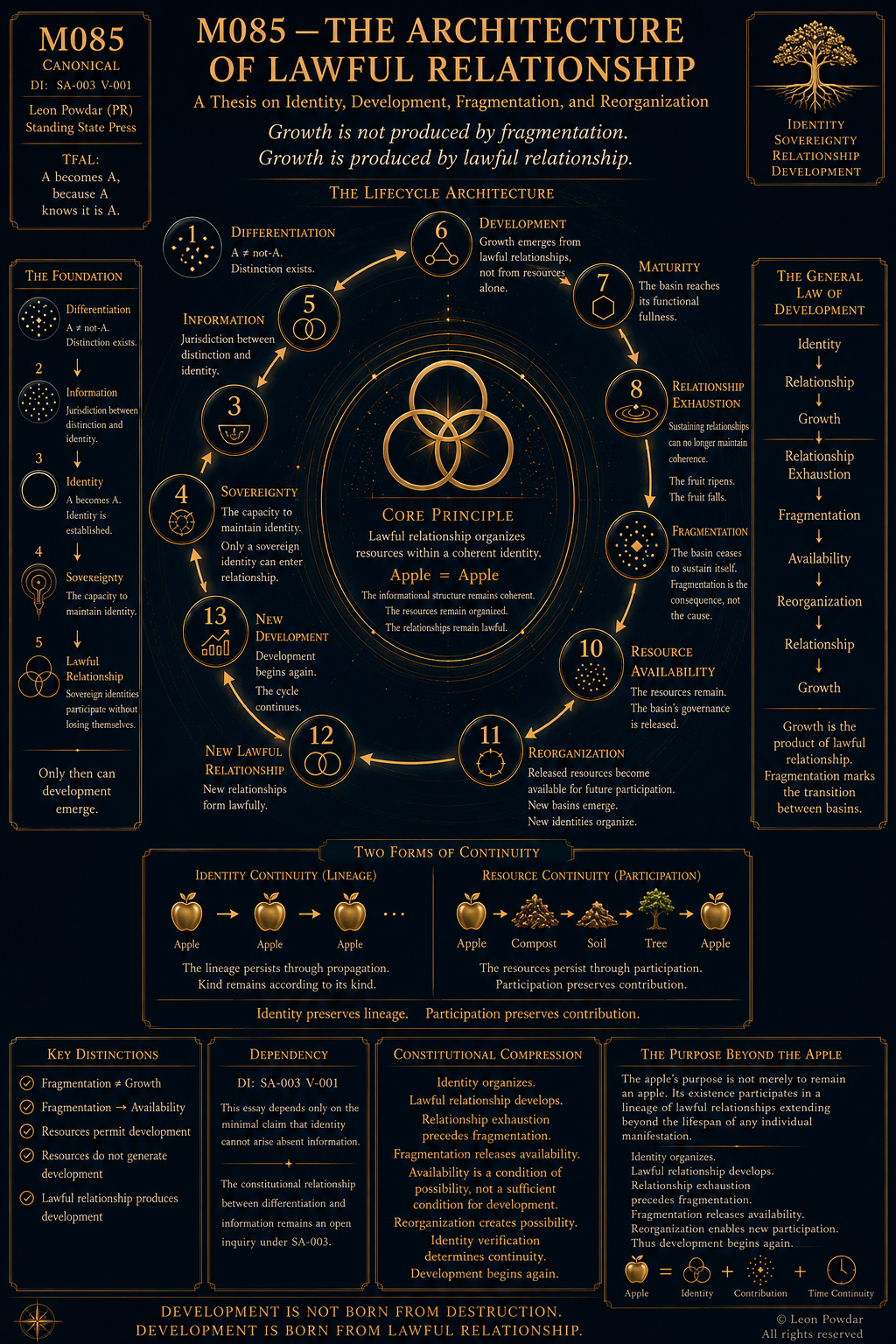
This essay proposes a generalized lifecycle architecture:
Differentiation → Information → Identity → Sovereignty → Lawful Relationship →
Development → Maturity → Relationship Exhaustion → Fragmentation →
Resource Availability → Reorganization → New Lawful Relationship → New Development
The present work depends only upon the minimal claim that identity cannot arise absent information. The constitutional relationship between differentiation and information remains an open inquiry under DI: SA-003 V-001.
The central claim of this work is that lawful relationship is the engine of development, while fragmentation serves as the constitutional transition between basins of organization.
Growth is often associated with accumulation. A tree becomes larger. An organism becomes stronger. A civilization becomes more complex.
Yet accumulation alone does not explain development.
A pile of minerals does not become a tree. A reservoir of water does not become an apple. Stored energy does not spontaneously become organization.
Resources permit development.
Resources do not generate development.
Something else must be present. The missing component is lawful relationship.
Development emerges when differentiated elements participate in relationships capable of sustaining a coherent identity through time.
Growth is therefore not a property of resources alone. Growth is a property of organized participation.
Before relationship can occur, identity must exist. Before identity can exist, distinction must exist.
Differentiation establishes: A ≠ not-A
Without distinction, nothing can be referenced. Without reference, nothing can be identified.
This essay acknowledges information as the jurisdiction between distinction and identity. Whether information emerges from differentiation, appears simultaneously with differentiation, or proves to be another description of differentiation itself remains an open inquiry under DI: SA-003 V-001.
What matters here is the dependency: identity does not arise absent information. Identity requires something available to distinguish, recognize, or reference.
Differentiation → Information → Identity
The present work proceeds from that minimal dependency without attempting to resolve the deeper inquiry.
Identity makes sovereignty possible. A thing must first be itself before it can participate in relationship.
The seed remains a seed. The tree remains a tree. The apple remains an apple.
Sovereignty is not isolation. Sovereignty is the capacity to maintain identity.
Only a sovereign identity can enter relationship without losing itself.
Differentiation → Information → Identity → Sovereignty
Only then can lawful relationship emerge.
The apple illustrates the principle clearly.
The apple develops because numerous elements participate in lawful relationship: Seed + Tree + Sunlight + Water + Soil + Time. None independently produce an apple.
The apple emerges because these elements participate within an organized basin governed by a coherent identity.
Lawful relationship does not replace identity. It is the lawful participation of sovereign identities while each remains according to its own becoming.
Throughout development:
Apple = Apple
The informational structure remains coherent.
The resources remain organized.
The relationships remain lawful.
Development therefore arises not from resources alone but from the relationships that organize them.
Identity organizes.
Lawful relationship develops.
Every basin possesses limits. At some point the relationships sustaining an identity can no longer maintain coherence.
The fruit ripens. The fruit falls. The sustaining relationships begin to fail.
A crucial distinction emerges.
Fragmentation is not the cause of basin failure. Fragmentation is the consequence of basin failure.
Relationship Exhaustion → Fragmentation
The basin ceases to sustain itself. Fragmentation follows. This stage is therefore not destruction. It is the exhaustion of a governing relationship.
Once coherence collapses, the basin loses governance over the resources previously organized within it.
The sugars remain. The minerals remain. The biological material remains. The stored energy remains. What disappears is not matter. What disappears is the basin's ability to maintain organizational coherence.
The resources become available.
Availability is a condition of possibility. It is not a sufficient condition for development.
Fragmentation ≠ Growth
Fragmentation → Availability
Fragmentation releases participation capacity. It does not create development. Development still requires organization.
The lifecycle does not terminate in fragmentation. Released resources become available for future participation.
Apple → Compost → Soil → Tree → Apple
or
Apple → Compost → Soil Organism → Different Plant
The resources participate in new lawful relationships. New basins emerge. New identities organize. Development begins again.
Identity → Participation → Development → Release → Reorganization → Identity
The lifecycle reveals two distinct forms of continuity.
Identity Continuity
Apple → Apple → Apple
The lineage persists through propagation. Kind remains according to its kind.
Resource Continuity
Apple → Compost → Soil → Tree → Apple
The resources persist through participation.
These continuities are related yet distinct. Lineage preserves identity. Participation preserves contribution.
The apple does not become the next apple. The apple contributes to the conditions that permit future apples.
Identity preserves lineage.
Participation preserves contribution.
The architecture developed throughout this essay may be compressed into a simple form:
Identity → Relationship → Growth
Relationship Exhaustion → Fragmentation
Fragmentation → Availability
Availability → Reorganization
Relationship → Growth
Identity organizes.
Lawful relationship develops.
Fragmentation releases.
Reorganization initiates a new cycle of development.
Growth is not the product of destruction. Growth is the product of lawful relationship. Fragmentation marks the transition between basins.
Life may be understood as the continual participation of sovereign identities within lawful relationships that preserve coherence while enabling development.
An identity organizes resources into a coherent basin. Lawful relationship sustains that basin through time. When coherence can no longer be maintained, relationship exhaustion precedes fragmentation.
Fragmentation releases participation capacity. Released resources become available for future organization. New lawful relationships emerge. Development begins again.
The apple therefore reveals a principle far larger than itself. Its purpose is not merely to remain an apple. Its existence participates in a lineage of lawful relationships extending beyond the lifespan of any individual manifestation.