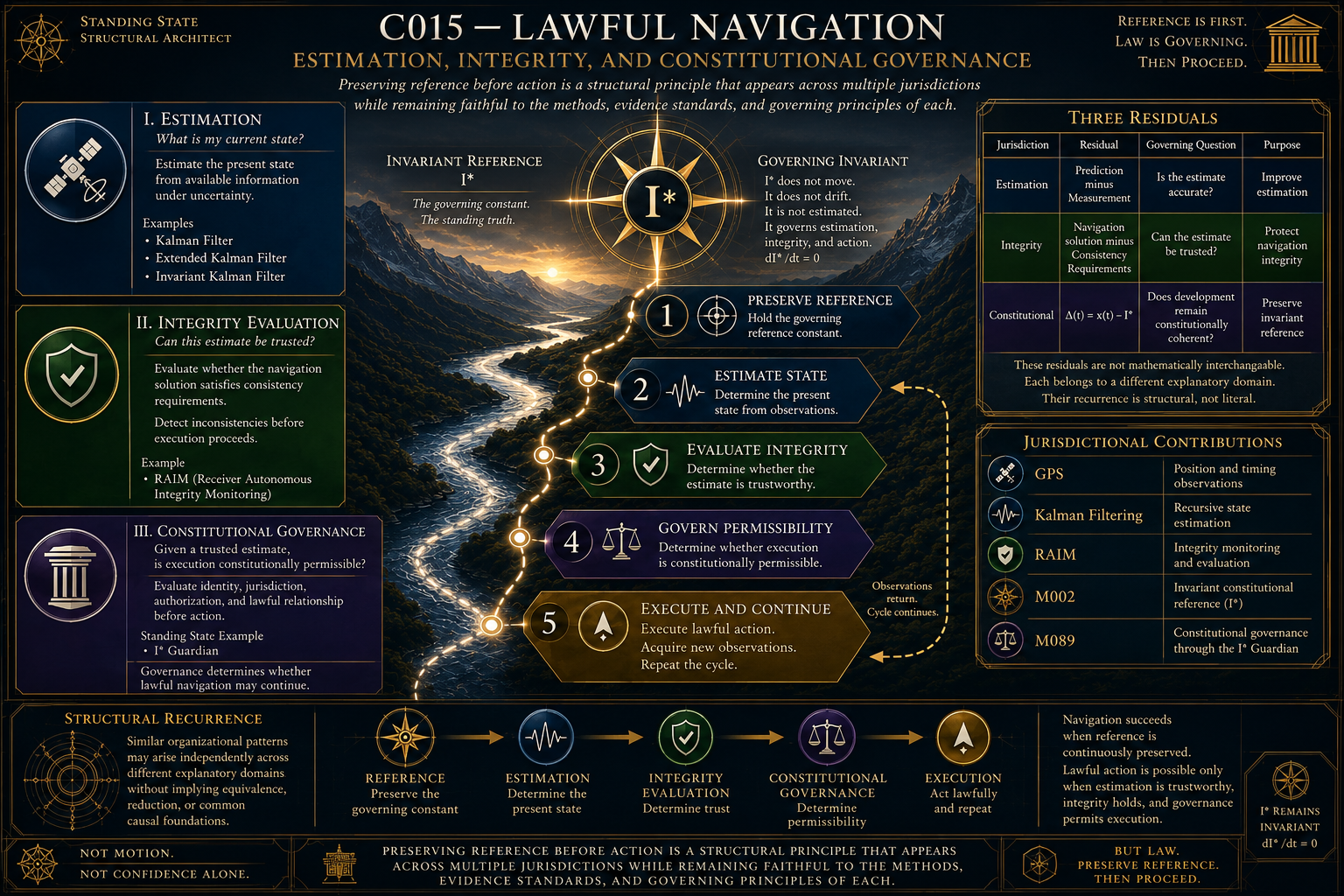
Navigation is not merely the computation of position. It is the lawful preservation of reference throughout motion.
Across engineering systems, successful navigation depends upon three distinct functions: estimation, integrity evaluation, and governance. Although these functions arise within different explanatory jurisdictions, they exhibit a recurring architectural structure.
This paper proposes that the recurrence is architectural rather than reductive. Engineering systems estimate state, evaluate integrity, and correct trajectory through recursive interaction with reality. The Standing State framework proposes an analogous constitutional sequence in which invariant reference governs lawful development through continual verification and recalibration.
Preserving reference before action is a structural principle that appears across multiple jurisdictions while remaining faithful to the methods, evidence standards, and governing principles of each.
The claim is not that GPS, Kalman filtering, or Receiver Autonomous Integrity Monitoring (RAIM) prove constitutional governance. Rather, they illustrate that successful navigation repeatedly depends upon preserving an appropriate reference before execution.
Navigation is often understood as determining where something is.
More fundamentally, navigation is the continual preservation of lawful reference throughout motion.
Every successful navigation system must repeatedly answer three different questions:
1. Where am I?
2. Can that answer be trusted?
3. Given that answer, may I proceed?
These questions belong to different explanatory jurisdictions.
The first concerns estimation.
The second concerns integrity.
The third concerns governance.
Confusing these jurisdictions obscures both engineering practice and constitutional reasoning.
The purpose of this paper is not to collapse these domains into one another, but to observe that they repeatedly exhibit a common organizational architecture while remaining methodologically independent.
Navigation requires three distinct functions operating within separate explanatory jurisdictions.
Although they interact continuously, they should not be conflated.
1. Estimation
Question: What is my current state?
State estimation predicts and updates the present coordinate from available information.
Representative engineering methods include: Kalman Filter, Extended Kalman Filter, Invariant Kalman Filter.
Their purpose is to estimate position, velocity, orientation, or other system states despite uncertainty.
Estimation seeks the best available description of the present state.
2. Integrity Evaluation
Question: Can this estimate be trusted?
Integrity evaluation determines whether an estimated navigation solution satisfies the consistency requirements necessary for reliable operation.
Integrity monitoring is the operational process through which these evaluations are performed continuously during navigation.
Representative engineering example: Receiver Autonomous Integrity Monitoring (RAIM).
Integrity does not determine motion. Integrity determines confidence.
Its purpose is to detect inconsistencies before execution proceeds.
3. Constitutional Governance
Question: Given a trusted estimate, is execution constitutionally permissible?
Governance evaluates identity, jurisdiction, authorization, and lawful relationship before action.
Within the Standing State framework this function is represented by the I* Guardian.
Its role is not to improve estimation. Its role is not to detect sensor faults.
Its purpose is to preserve invariant reference by determining whether execution is permissible under the governing invariant.
Governance determines whether lawful navigation may continue.
Although these functions belong to different explanatory jurisdictions, each compares the present condition against an appropriate governing reference.
| Jurisdiction | Residual | Governing Question | Purpose |
|---|---|---|---|
| Estimation | Prediction versus measurement | Is the estimate accurate? | Improve estimation |
| Integrity | Navigation solution versus consistency requirements | Can the estimate be trusted? | Protect navigation integrity |
| Constitutional | Δ(t) = x(t) − I* | Does development remain constitutionally coherent? | Preserve invariant reference |
These residuals are not mathematically interchangeable.
Each belongs to its own explanatory domain.
Their recurrence is structural rather than literal.
Each identifies whether correction is required before execution proceeds.
Across these jurisdictions a common architectural sequence repeatedly appears.
1. Preserve a governing reference.
2. Estimate the present state.
3. Evaluate integrity.
4. Govern constitutional permissibility.
5. Execute lawful action.
Execution produces new observations. Those observations initiate another estimation. The sequence therefore operates recursively.
Engineering systems implement this architecture mathematically. Standing State expresses the same architecture constitutionally.
The mechanisms differ. The organizational structure recurs.
| Jurisdiction | Contribution |
|---|---|
| GPS | Position and timing observations |
| Kalman Filtering | Recursive state estimation |
| RAIM | Integrity monitoring and integrity evaluation |
| M002 | Invariant constitutional reference (I*) |
| M089 | Constitutional governance through the I* Guardian |
Each contributes within its own explanatory scope. None reduces to another. No single jurisdiction exhausts the architecture of lawful navigation.
C014 proposed that lawful developmental structures may recur across distinct explanatory jurisdictions without reducing those jurisdictions to one another.
C015 applies that methodology to navigation.
Architectural recurrence indicates that similar organizational patterns may arise independently across different explanatory domains without implying identical mechanisms, evidence standards, mathematical formulations, or causal foundations.
Successful navigation repeatedly exhibits the following architectural sequence:
Standing State introduces constitutional governance as an additional explanatory jurisdiction concerned with lawful execution rather than state estimation or integrity verification.
The recurrence therefore concerns organization rather than equivalence.
Engineering navigation demonstrates that estimation alone is insufficient.
An accurate estimate without integrity evaluation may be unsafe.
A trustworthy estimate without lawful governance may still be impermissible.
Each function answers a different question. Each protects a different aspect of navigation. Together they preserve continuity between reference and action.
The Standing State framework proposes that constitutional governance occupies a distinct jurisdiction beyond estimation and integrity.
Whether that proposal proves fruitful depends upon constitutional inquiry rather than engineering validation.
Engineering and constitutional reasoning therefore remain complementary rather than reducible.
Navigation succeeds when reference is continuously preserved.
Engineering systems accomplish this through recursive estimation together with integrity evaluation and monitoring.
Constitutional systems require an additional governing layer that evaluates lawful identity, jurisdiction, authorization, and relationship before execution proceeds.
Across engineering and constitutional frameworks alike, successful navigation depends upon preserving an appropriate reference before action.
The mechanisms differ. The evidence standards differ. The governing principles differ.
Yet the architectural sequence—
—recurs across these jurisdictions without collapsing one into another.
The recurrence is architectural. It neither reduces engineering to philosophy nor philosophy to engineering.
Instead, it identifies a common organizational structure while preserving the integrity, methods, and explanatory scope of each domain.