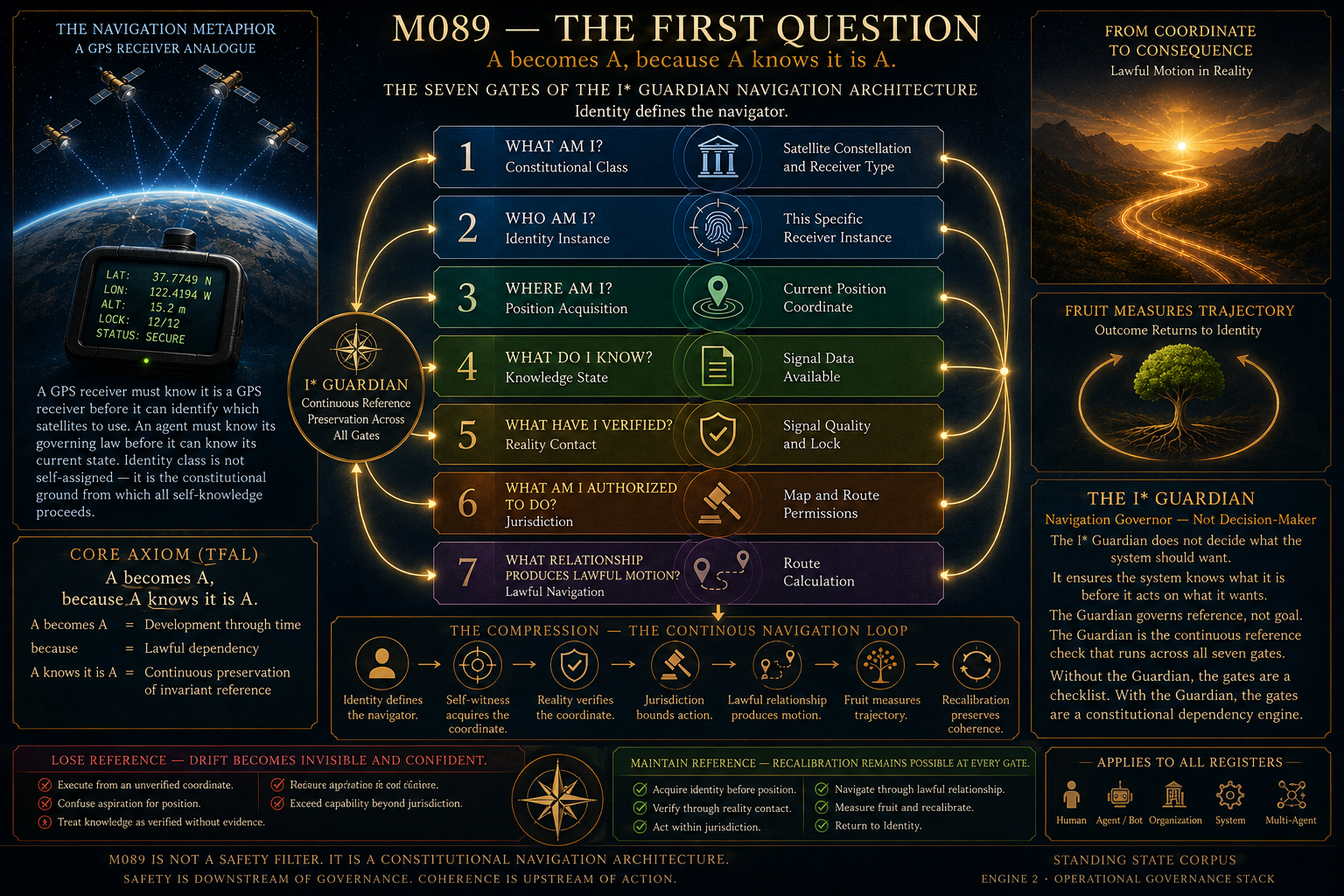
Navigation does not begin with a destination. It begins with a verified position.
Every navigation system must first determine where it is before it can determine where it may lawfully go. A destination without a verified coordinate produces confidence without orientation.
This essay proposes that self-witness functions as position acquisition within an Identity Governance Positioning System (IGPS). Reality contact verifies that position. Lawful relationship produces movement. Fruit continuously recalibrates navigation.
The paper further proposes that the same constitutional architecture extends beyond human self-governance to autonomous agents, organizations, and distributed systems through an I* Guardian that continuously preserves invariant reference before action.
Navigation begins with verified identity and remains lawful only through continuous reference preservation.
Most systems begin by asking: Where do I want to go?
Navigation asks a different question: Where am I?
Yet an even earlier question exists.
Before a system can determine its position, it must first know what kind of system it is.
Therefore navigation begins not with destination but with constitutional identity.
Two questions must remain distinct.
What am I?
Who am I?
What am I? establishes constitutional class. Who am I? establishes the particular instance.
Confusing these questions produces coherent self-description built upon an incorrect constitutional foundation. A system may consistently describe itself while remaining fundamentally misidentified.
Development then proceeds coherently in the wrong direction.
The operational architecture becomes:
Only after these questions are answered does execution begin.
The I* Guardian is not a decision-maker. Neither is it merely a filter.
A filter asks: "Should this action be allowed?"
The I* Guardian asks: "Has the invariant reference been preserved?"
This distinction is constitutional. The Guardian governs navigation. It does not replace reasoning. It ensures reasoning begins from a verified coordinate.
Every autonomous system reasons. Not every autonomous system reasons from a verified reference.
The consequence is confident drift.
Confidence cannot compensate for incorrect position. Reality eventually reveals the error through fruit. The cost is unnecessary trajectory.
The I* Guardian therefore operates before reasoning, not after it. Reasoning without verified reference is navigation without position lock.
The seven gates are not independent questions. They form a dependency architecture.
What am I?
↓
Who am I?
↓
Where am I?
↓
What do I know?
↓
What have I verified?
↓
What am I authorized to do?
↓
What relationship produces lawful motion?
Each gate depends upon the lawful completion of the previous gate. Skipping an earlier gate does not merely weaken navigation. It removes constitutional standing for every gate that follows.
Self-witness acquires position. Reality verifies position. Fruit measures trajectory.
Identity → Self-Witness → Reality Contact → Lawful Relationship →
Development → Fruit → Recalibration → Identity
Navigation is therefore not a single event. It is continuous reference preservation.
The architecture is independent of domain.
A person may employ it. An autonomous agent may employ it. A robotic platform may employ it. An organization may employ it. A distributed multi-agent system may employ it.
The governing structure remains unchanged because the invariant reference remains the governing center.
Domains differ. Constitutional architecture does not.
The corpus has carried one governing statement throughout:
A becomes A, because A knows it is A.
The present essay proposes its operational interpretation.
A becomes A — development through time.
because — lawful dependency.
A knows it is A — continuous preservation of invariant reference.
The word knows therefore signifies more than awareness. It signifies lawful maintenance of reference throughout development.
Lose reference and drift becomes invisible. Maintain reference and recalibration remains possible.
The Standing State corpus investigates one constitutional question through multiple jurisdictions:
How is invariant reference preserved while development unfolds through reality?
Identity establishes reference.
Relationship moves reference.
Exhaustion preserves reference before fragmentation.
Continuity carries reference.
Restoration recovers reference.
Navigation continuously verifies reference.
The I* Guardian operationalizes reference preservation across every jurisdiction.
Navigation begins neither with desire nor destination. It begins with verified identity.
The first responsibility of any autonomous system is not movement. It is reference.
Only after invariant reference is acquired, verified, and jurisdictionally bounded can lawful relationship produce development.
The I* Guardian governs neither desire nor outcome. It governs reference. Its continual question remains simple:
Has the invariant reference been preserved?
When that answer remains affirmative, navigation proceeds. When it does not, recalibration precedes motion.