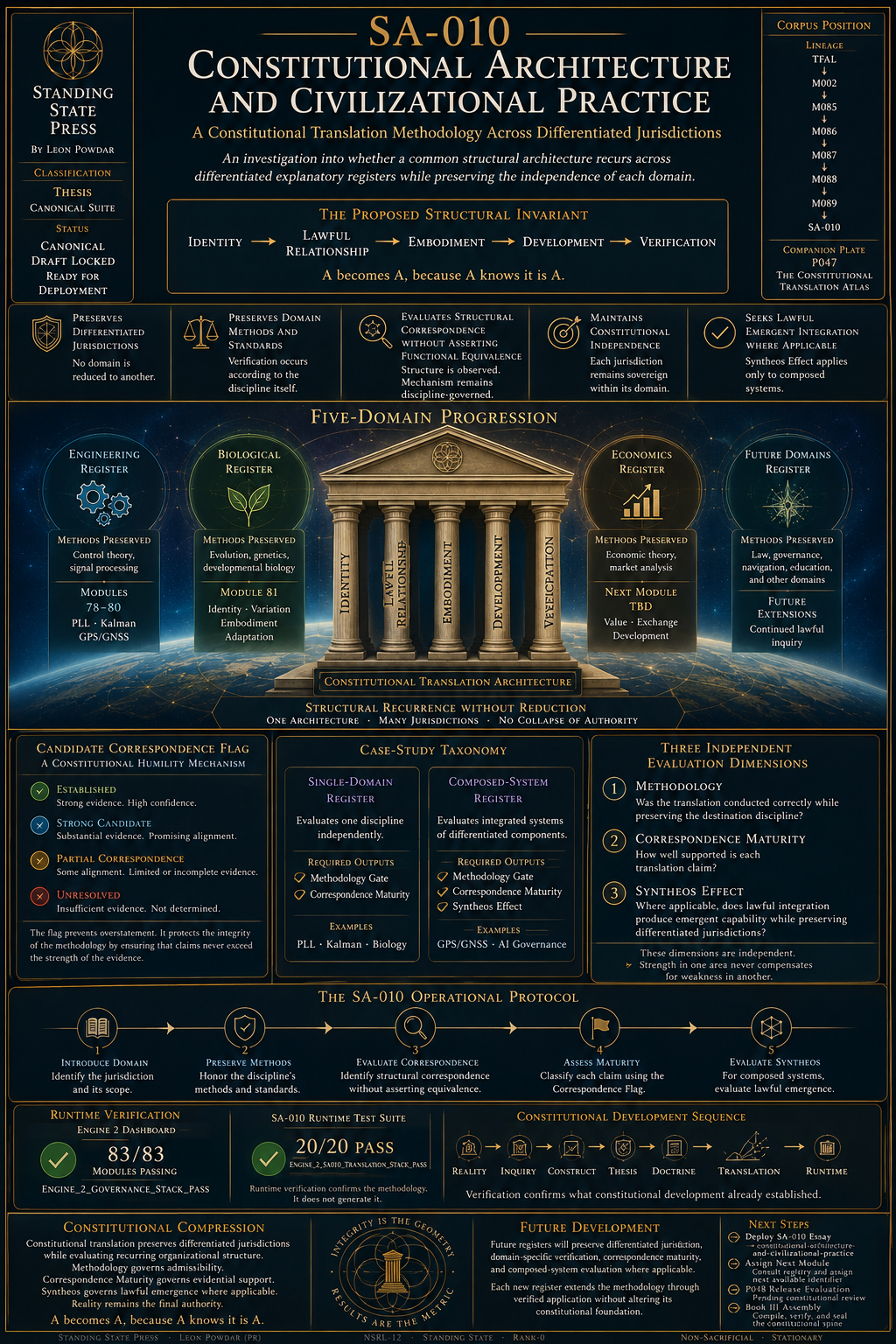
This essay presents a constitutional translation methodology for evaluating whether a common structural architecture — Identity → Lawful Relationship → Embodiment → Development → Verification — recurs across differentiated explanatory registers while preserving the independence of each domain.
The methodology does not assert functional equivalence between domains. It evaluates structural correspondence while preserving each jurisdiction's own methods, standards of verification, and governing principles. No domain is reduced to another.
Five application registers are documented: engineering (PLL, Kalman, GPS/GNSS), evolutionary biology, and AI governance. These span three domain families and constitute five verified case studies. The methodology is confirmed by executable Engine 2 runtime verification in addition to constitutional exposition.
The Standing State corpus establishes four methodological criteria governing constitutional translation.
1. Preserves Differentiated Jurisdictions. No domain is reduced to another. Each jurisdiction retains its own methods, standards, and governing principles.
2. Preserves Domain Methods and Standards. Verification occurs according to the discipline itself. Constitutional translation does not import constitutional language as a substitute for domain-specific evidence.
3. Evaluates Structural Correspondence without Asserting Functional Equivalence. Structure is observed. Mechanism remains discipline-governed.
4. Maintains Constitutional Independence. Each jurisdiction remains sovereign within its domain. Syntheos Effect applies only to composed systems.
These criteria were established at the opening of the SA-010 inquiry and remain unchanged throughout all subsequent case studies. No new case study modifies them. Each new register is evaluated against them.
The first three SA-010 case studies were conducted within engineering domains. Each preserves control theory, signal processing, and estimation-theory jurisdiction while evaluating structural correspondence to the proposed invariant.
The Phase-Locked Loop constitutes the first engineering case study. Reference, feedback, lock, tracking, and verification remain engineering functions. Structural recurrence is evaluated constitutionally without asserting that the PLL operates by constitutional principles or that constitutional architecture operates by signal processing.
Correspondence Maturity: Established · Methodology: Admissible
The Kalman Filter applies recursive estimation to the problem of maintaining accurate state knowledge under noisy conditions. State-space model, prediction-correction, posterior estimate, recursive estimation, innovation, and covariance remain estimation-theory functions. Structural recurrence is evaluated constitutionally while preserving estimation-theory jurisdiction.
Correspondence Maturity: Established · Methodology: Admissible
GPS/GNSS extends the SA-010 methodology from single-domain correspondence to composed-system admissibility. PLL and Kalman remain differentiated engineering subsystems. The composed system is evaluated for component integrity, integration integrity, jurisdiction preservation, and local/global structural correspondence. The Syntheos Effect is evaluated as an independent dimension.
Correspondence Maturity: Established · Methodology: Admissible · Syntheos: Present
Module 81 introduces the first non-engineering case study. Evolutionary biology is governed by its own methods — evolution, genetics, developmental biology — and these methods retain full authority throughout the register.
The biological register evaluates structural correspondence claims across heritable information, organism-environment constraint, phenotype, population change, and fitness outcomes. Each claim receives an explicit maturity label. The Candidate Correspondence Flag is introduced here as a constitutional instrument.
Admissibility is separated from correspondence maturity. A register may be methodologically admissible while containing Partial Correspondence claims. These are distinct constitutional questions.
Embodiment receives a Partial Correspondence designation — not because the biological concept of embodiment is inadequate, but because the translation claim between constitutional embodiment and biological embodiment requires further evidential development.
Reality functions as constraint rather than preference or intention.
The biological register extends constitutional translation without replacing biological science or its methods of verification. Evolutionary biology retains authority over mechanism while structural recurrence is evaluated constitutionally.
Correspondence Maturity: Mixed (Established · Strong Candidate · Partial Correspondence) · Methodology: Admissible
Module 82 introduces the first composed-system register outside engineering. AI governance is a composed system: agents, tools, memory, planning, verification, and oversight each constitute differentiated subsystems that must be evaluated for both individual correspondence and integration integrity.
AI governance continues to be governed by AI evaluation, monitoring, red-teaming, auditing, and safety practices. Constitutional translation does not substitute for these practices. It evaluates structural correspondence while they retain authority.
The case-study taxonomy is formalized. AI governance requires three independent evaluations: Methodology, Correspondence Maturity, and Syntheos Effect. These are constitutionally independent questions.
A case study may be methodologically admissible while containing Partial Correspondence. A composed system may exhibit lawful emergent integration without altering the admissibility criteria themselves. Strength in one dimension does not compensate for weakness in another.
Correspondence Maturity: Mixed · Methodology: Admissible · Syntheos: Conditional · Present where jurisdictions preserved
The Candidate Correspondence Flag is a constitutional safeguard introduced at Module 81 and applied across all subsequent registers. Its purpose is not merely to classify correspondence claims but to prevent the methodology from asserting more than the available evidence supports.
The flag functions as an explicit humility mechanism within the methodology. Without it, strong structural correspondence in one domain could be rhetorically transferred to another domain where evidence is insufficient. The flag prevents this overreach.
Established — Strong evidence. High confidence. The translation claim is well-supported across verified application.
Strong Candidate — Substantial evidence. Promising alignment. Further verification would strengthen the claim.
Partial Correspondence — Some alignment. Limited or incomplete evidence. The structural recurrence is intelligible but not yet sufficiently documented.
Unresolved — Insufficient evidence. Not yet determined. The claim requires further inquiry before any designation can be assigned.
These labels measure the evidential support for the translation claim rather than the maturity, authority, or validity of the source discipline itself. An Unresolved designation reflects the current state of the translation evidence, not a judgment on the discipline under investigation.
All SA-010 case studies fall into one of two constitutional categories. The category determines the required evaluation outputs.
Evaluates one discipline independently.
Required outputs:
Methodology Gate
Correspondence Maturity
Examples: PLL · Kalman · Biology
Evaluates integrated systems of differentiated components.
Required outputs:
Methodology Gate
Correspondence Maturity
Syntheos Effect
Examples: GPS/GNSS · AI Governance
Syntheos evaluation applies only where differentiated subsystems are integrated. It is not imposed retroactively upon single-domain studies. The taxonomy governs future applications without altering previously established registers.
The methodological core of SA-010 consists of three evaluation dimensions that are constitutionally independent. Independence is the protection. Collapsing these into a single verdict would allow strength in one to mask weakness in another.
1. Methodology
Was the constitutional translation conducted correctly while preserving the destination discipline?
2. Correspondence Maturity
How well supported is each translation claim? Maturity is assessed per claim, not globally asserted for the domain.
3. Syntheos Effect
Where applicable: does lawful integration produce emergent capability while preserving differentiated jurisdictions? Applies only to composed-system registers.
Methodological admissibility cannot compensate for weak correspondence.
Strong correspondence cannot compensate for methodological violations.
Emergent integration cannot compensate for either.
Their independence prevents epistemic overreach and preserves disciplined evaluation across all future SA-010 registers regardless of domain.
All future SA-010 domain registers follow a common constitutional sequence. This protocol governs future constitutional translation without altering previously established methodology.
Step 1. Introduce the new domain. Identify the jurisdiction and its scope.
Step 2. Preserve that domain's verification methods. Honor the discipline's methods and standards.
Step 3. Evaluate structural correspondence. Identify structural correspondence without asserting equivalence.
Step 4. Assess correspondence maturity. Classify each claim using the Candidate Correspondence Flag.
Step 5. Evaluate the Syntheos Effect where appropriate. For composed systems, evaluate lawful emergence.
The executable runtime documents constitutional development after the methodology has been established. The constitutional development sequence governs this relationship:
Runtime verification confirms constitutional development rather than generating it. The methodology was established through inquiry, construct, thesis, and doctrine before its executable implementation.
Five application fruits. Three domain families. Translation methodology operational. M089 Navigation Stack and SA-010 Translation Stack both confirmed independent runtime verification suites. These results demonstrate operational consistency with the constitutional methodology already established.
Future registers will preserve differentiated jurisdiction, domain-specific verification, correspondence maturity, and composed-system evaluation where applicable. Each additional register extends the methodology through verified application without altering its constitutional foundation.
Future domain candidates include economics (value, exchange, development), law and governance, navigation science, and education. Each must enter through the five-step operational protocol and submit to all three independent evaluation dimensions. The next module identifier will be assigned by consulting the Engine 2 module registry before opening the register, preserving registry continuity and preventing module-number collisions.
The inquiry has not yet matured to thesis. Persistence across genuinely independent domain families is required. Reality remains the final authority over whether the proposed structural invariant advances from constructive inquiry to constitutional doctrine.
Constitutional translation preserves differentiated jurisdictions while evaluating recurring organizational structure.
Methodology governs admissibility.
Correspondence Maturity governs evidential support.
Syntheos governs lawful emergence.
Runtime confirms constitutional development.
Reality remains the final authority.