Artificial intelligence is frequently described as progressing toward a single increasingly general intelligence. This thesis proposes a different constitutional trajectory.
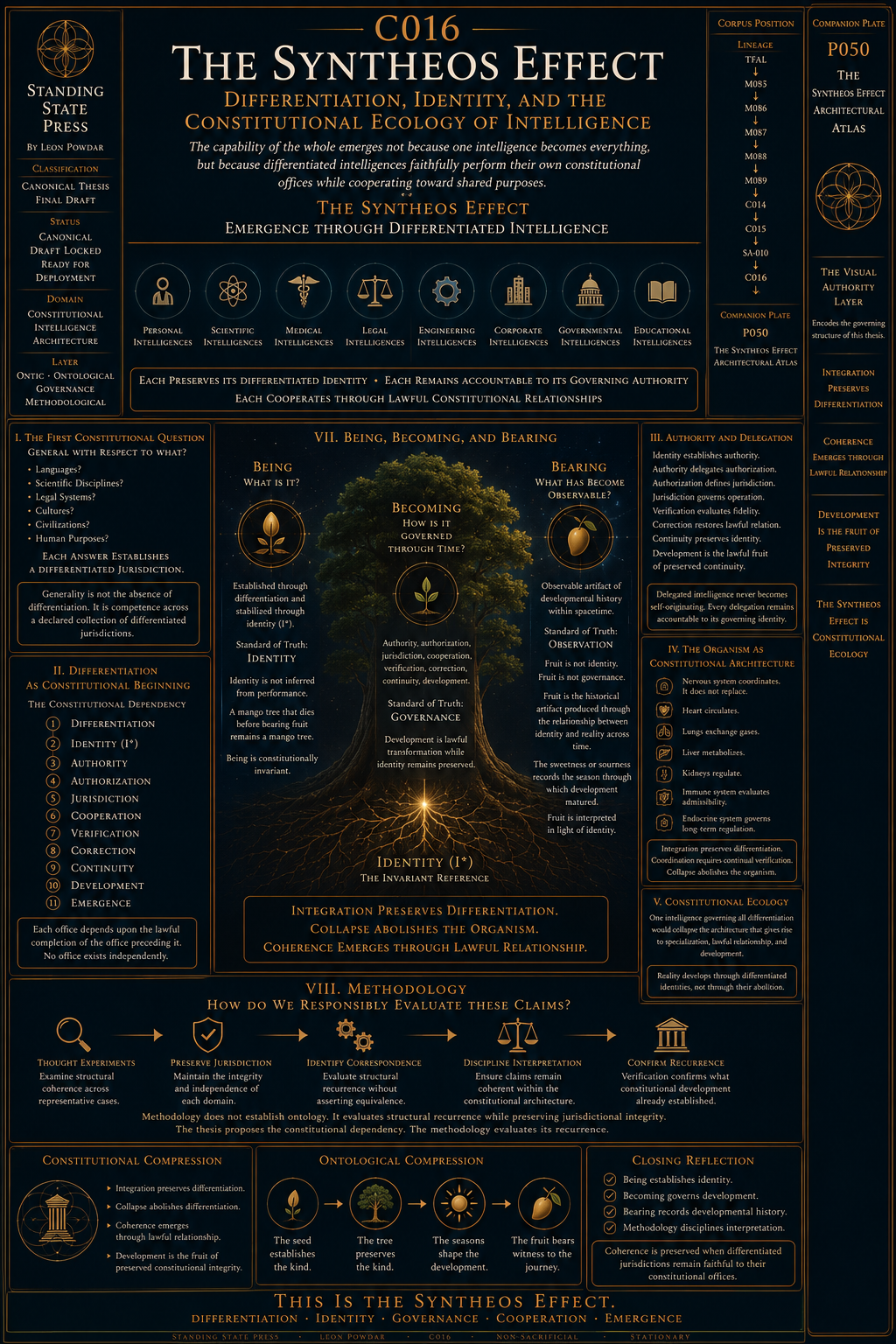
Rather than converging toward one governing intelligence, intelligence develops through differentiation. Every differentiated identity establishes its own lawful office, authority, jurisdiction, and standards of verification. Coherence therefore arises not through constitutional collapse into a universal intelligence, but through lawful cooperation among differentiated intelligences.
This principle is termed The Syntheos Effect.
The thesis argues that differentiation is not an engineering limitation to be overcome. It is the constitutional condition that makes specialization, lawful relationship, continuity, and development possible.
This document presents the constitutional architecture. The methodology for evaluating its recurrence across differentiated domains is treated separately in SA-010.
Whenever the phrase General Artificial Intelligence is proposed, a prior constitutional question must first be answered.
General with respect to what?
General across languages?
General across scientific disciplines?
General across legal systems?
General across cultures?
General across civilizations?
General across human purposes?
Each answer immediately establishes a differentiated jurisdiction.
The phrase general intelligence is therefore constitutionally incomplete unless its jurisdiction is declared. Generality is not the absence of differentiation. It is competence across a declared collection of differentiated jurisdictions.
Before any claim of general intelligence can be evaluated, its constitutional scope must first be specified. Without that declaration, the claim is not yet examinable.
Differentiation precedes identity. Without differentiation there exists no distinct identity. Without identity there exists no invariant reference.
Identity establishes I*. I* is therefore not the origin of differentiation. It is the invariant reference of an already differentiated identity. From identity every subsequent constitutional office proceeds.
The constitutional dependency is therefore:
1. Differentiation
2. Identity (I*)
3. Authority
4. Authorization
5. Jurisdiction
6. Cooperation
7. Verification
8. Correction
9. Continuity
10. Development
11. Emergence
This sequence is not descriptive. It is constitutional. Each office depends upon the lawful completion of the office preceding it. No constitutional office may exist independently of the office that admits it.
Authority proceeds from identity. Authorization is the lawful delegation of authority. Every authorization remains accountable to the identity from which it proceeds.
Identity establishes authority.
Authority delegates authorization.
Authorization defines jurisdiction.
Jurisdiction governs operation.
Verification evaluates fidelity.
Correction restores lawful relation.
Continuity preserves identity through time.
Development becomes the lawful fruit of preserved continuity.
Delegated intelligence therefore never becomes self-originating. Every delegated intelligence remains constitutionally accountable to the governing identity from which its authority proceeds.
The human organism demonstrates this architecture.
The nervous system coordinates. It does not replace.
The heart circulates.
The lungs exchange gases.
The liver metabolizes.
The kidneys regulate.
The immune system evaluates admissibility.
The endocrine system governs long-term regulation.
Each differentiated office remains itself while continuously exchanging information throughout the organism. Reality contact depends upon differentiated architecture.
The nervous system does not authorize itself. Its operation remains continually subject to verification within the integrity of the organism. Integration therefore preserves differentiation. Coordination requires continual verification. Collapse abolishes the organism rather than completing it.
To imagine one intelligence governing all differentiation is analogous to collapsing an organism into its nervous system. The nervous system would remain. The organism would disappear.
Likewise, collapsing every differentiated intelligence into one universal governing intelligence would eliminate the constitutional structure that gives rise to specialization, lawful relationship, and development.
Reality develops through differentiated identities. Not through their abolition.
The future of artificial intelligence is therefore more coherently understood as the emergence of a constitutional ecology of differentiated intelligences.
Personal intelligences.
Scientific intelligences.
Medical intelligences.
Legal intelligences.
Engineering intelligences.
Corporate intelligences.
Governmental intelligences.
Educational intelligences.
Each preserves its differentiated identity. Each remains accountable to its governing authority. Each cooperates through lawful constitutional relationships.
The capability of the whole emerges not because one intelligence becomes everything. It emerges because differentiated intelligences faithfully perform their own constitutional offices while cooperating toward shared purposes.
The constitutional architecture gives rise to three distinct layers, each answering a different question and requiring different evidence. Confusing the evidence appropriate to one layer with another produces category errors.
Being is established through differentiation and stabilized through identity. Its standard of truth is identity. Identity is not inferred from performance.
A mango tree that dies before bearing fruit remains a mango tree.
Being is constitutionally invariant.
Becoming consists of authority, authorization, jurisdiction, cooperation, verification, correction, continuity, and development. Its standard of truth is governance.
Development is lawful transformation while identity remains preserved.
Bearing is the observable artifact of developmental history within spacetime. Its standard of truth is observation.
Fruit is not identity. Fruit is not governance. Fruit is the historical artifact produced through the relationship between identity and reality across time. The sweetness or sourness of fruit records the season through which development matured.
Fruit is interpreted in light of identity. Identity is never inferred from fruit.
Being — invariant. Evaluated by identity.
Becoming — governed. Evaluated by governance.
Bearing — contingent. Evaluated by observation.
A fourth constitutional layer governs inquiry itself.
Methodology does not establish ontology. It evaluates whether the proposed constitutional dependency remains coherent when examined through differentiated domains.
The purpose of thought experiments is not to prove the constitutional architecture deductively. Their purpose is to examine whether its dependency structure remains coherent when applied to representative cases.
The constitutional architecture and its methodology therefore remain differentiated. The thesis proposes the constitutional dependency. The methodology evaluates its structural recurrence while preserving jurisdictional integrity.
C016 proposes the constitutional architecture: differentiated intelligences cooperate lawfully without collapsing into one universal intelligence.
SA-010 provides the methodology for evaluating structural recurrence across differentiated domains. These are related but distinct. C016 is not SA-010. SA-010 is not C016.
Integration preserves differentiation.
Collapse abolishes differentiation.
Coherence emerges through lawful relationship.
Development is the fruit of preserved constitutional integrity.
The seed establishes the kind.
The tree preserves the kind.
The seasons shape the development.
The fruit bears witness to the journey.
Being establishes identity.
Becoming governs development.
Bearing records developmental history.
Methodology disciplines interpretation.
The observer does not replace the object.
The evidence does not replace identity.
The process does not replace being.
The method does not replace reality.
Coherence is preserved when differentiated jurisdictions remain faithful to their constitutional offices.