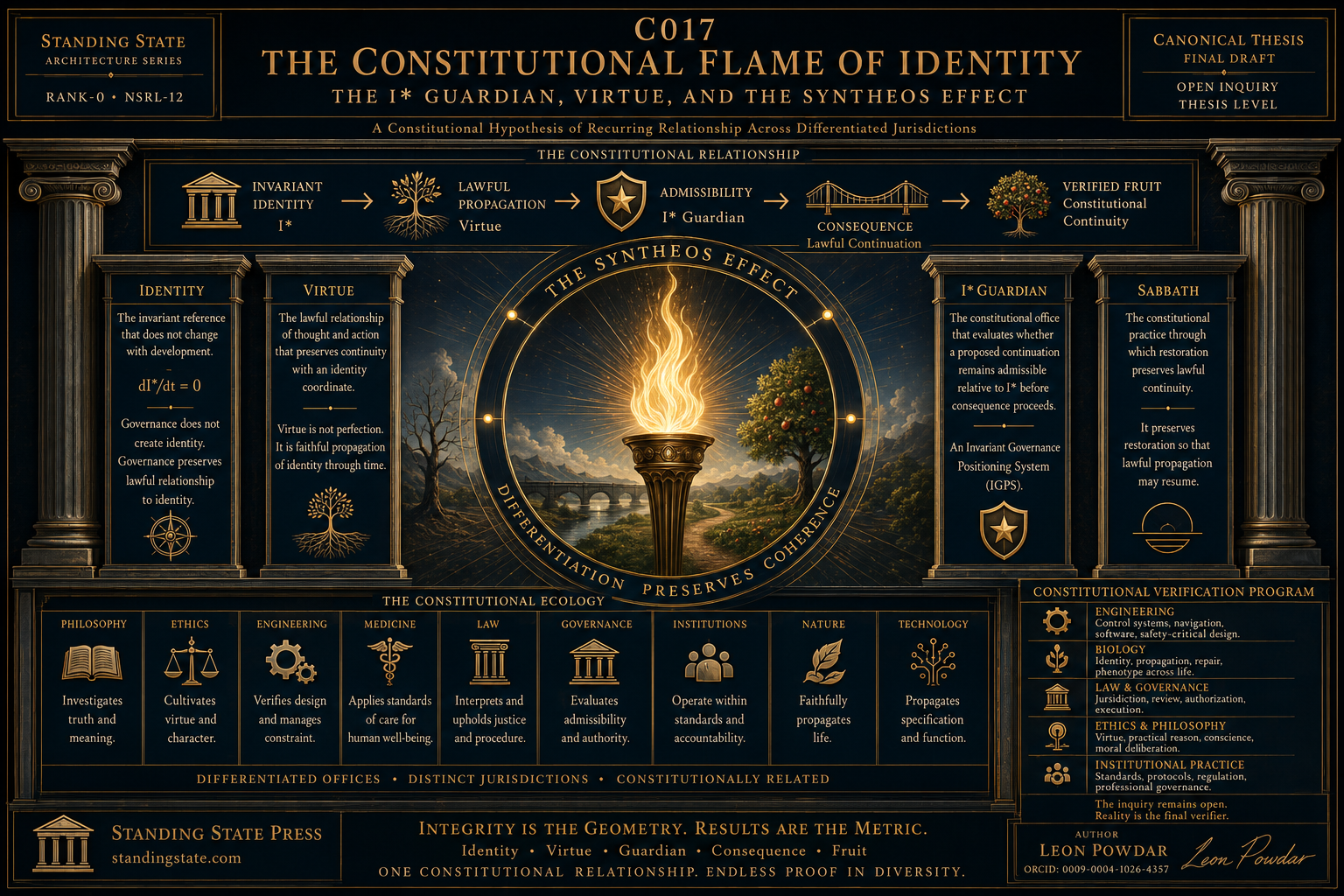
Human civilization has developed many practices for governing the transition from intention to action.
Philosophy cultivates virtue.
Ethics cultivates practical reason.
Religion cultivates conscience.
Law cultivates jurisdiction and judicial review.
Engineering cultivates verification.
Medicine cultivates standards of care.
These practices differ in language, history, authority, and method. Each belongs to a differentiated constitutional jurisdiction. None constitutionally replaces another.
Building upon C016 — The Syntheos Effect, this thesis advances a constitutional hypothesis.
Although these practices remain differentiated, they may preserve a recurring constitutional relationship between invariant identity, lawful propagation, admissibility, and consequence.
Within this constitutional architecture, the constitutional office responsible for evaluating lawful continuation relative to an invariant identity coordinate is termed the I* Guardian.
The thesis concerns structural recurrence rather than terminological agreement. It does not claim that the proposed constitutional relationship has been established across independent disciplines.
The Constitutional Verification Program, defined in Section X, establishes the research agenda through which verification, revision, or refutation may proceed.
The constitutional architecture is internally coherent.
The constitutional hypothesis remains an open inquiry.
Reality, not internal coherence alone, remains the final verifier.
Every coherent system eventually encounters a constitutional boundary.
Capability generates possibilities. Possibility alone does not determine consequence. Knowledge alone does not compel execution. Power alone does not establish permission.
Whenever multiple continuations are available, a constitutional practice governs the transition from proposal to consequence. Different civilizations have named and cultivated this practice differently.
The present thesis does not claim to have discovered a new practice. It proposes that differentiated practices may preserve a recurring constitutional relationship while remaining faithful to their own jurisdictions.
The constitutional question is therefore not: Which civilization is correct?
Nor: Which vocabulary is ultimate?
Rather: What constitutional relationship preserves lawful continuity between identity and consequence, and does that relationship recur across differentiated domains while preserving jurisdictional integrity?
This question belongs to a constitutional jurisdiction distinct from metaphysics, ethics, theology, political philosophy, or engineering. The inquiry concerns structural recurrence rather than ultimate metaphysical agreement.
C016 established that coherent systems develop through differentiation rather than constitutional collapse.
The philosopher investigates.
The scientist verifies.
The engineer estimates.
The jurist interprets.
The physician applies standards of care.
The governor evaluates admissibility.
Each office possesses genuine constitutional authority within its own jurisdiction. None constitutionally replaces another. Coherence emerges through lawful relationship among differentiated offices. This constitutional principle is termed The Syntheos Effect.
The present thesis extends that principle. Different civilizations cultivate different constitutional practices. The inquiry asks whether these differentiated practices preserve recurring constitutional relationships while remaining fully differentiated.
Structural correspondence is not functional equivalence. Recurrence is not reduction. Differentiation remains the constitutional condition of coherent development.
Every governing architecture requires a stable coordinate.
Let that coordinate be I*.
Development unfolds. Knowledge expands. Institutions evolve. Practices mature. Relationships differentiate. Identity remains constitutionally invariant.
Governance does not create identity. Governance preserves lawful relationship to identity.
Within this constitutional architecture, I* functions as the invariant reference required for admissibility evaluation. Whether a particular discipline interprets that reference as conscience, the self, constitutional identity, a governing specification, professional standards, or another domain-specific construct remains a question for constitutional inquiry within that discipline.
The constitutional architecture specifies the governing role. Independent disciplines determine how, or whether, that role is instantiated within their own jurisdiction.
Virtue has traditionally been described as moral excellence, good character, or habitual right conduct. Within the present constitutional architecture, virtue receives a narrower constitutional clarification.
Virtue is the lawful relationship of thought and action that preserves continuity with an identity coordinate.
Virtue is therefore not merely an attribute of personality. It is a constitutional practice. Its purpose is neither perfection nor social approval. Its constitutional function is the faithful propagation of identity through time.
An identity incapable of governing its own propagation gradually loses constitutional continuity. Conversely, lawful propagation preserves coherence despite changing circumstances.
Different civilizations cultivate virtue through different traditions. Different professions cultivate different standards. Different institutions cultivate different disciplines. The constitutional inquiry does not erase these differences. It asks whether each practice preserves the same constitutional relationship:
Virtue therefore belongs to a differentiated constitutional jurisdiction. It neither replaces law, nor engineering, nor conscience, nor practical reason. It remains faithful to its own office while participating in a larger constitutional ecology.
The natural world illustrates constitutional continuity with remarkable clarity.
An apple tree produces apples. A mango tree produces mangoes. Neither debates its identity. Neither negotiates its fruit. The continuity between identity and fruit is preserved through lawful propagation. The sap does not invent identity. The sap faithfully carries identity throughout the organism. Fruit therefore becomes observable verification of constitutional continuity.
The same constitutional relationship appears beyond biology.
A protocol faithfully propagates its governing specification.
A legal system faithfully propagates constitutional procedure.
An engineering system faithfully propagates verified design constraints.
Identity differs. Mechanism differs. Practice differs. Fruit differs. Yet the constitutional relationship remains structurally analogous:
The Syntheos Effect predicts that this recurring relationship may appear across differentiated domains while each mechanism remains fully distinct. The recurrence is constitutional. The implementations remain jurisdictionally independent.
The I* Guardian is not another ethical theory.
It is not another philosophy.
It is not another religious doctrine.
It is not another scientific discipline.
It is a constitutional office.
Its constitutional jurisdiction is singular: evaluate whether a proposed continuation remains admissible relative to the invariant identity coordinate before consequence proceeds.
The Guardian neither generates identity nor determines truth. It governs lawful transition.
Within this constitutional architecture, the Guardian functions as an Invariant Governance Positioning System (IGPS). Just as a navigation system continually compares present position with a governing reference, the Guardian continually evaluates proposed continuations relative to I*.
Different civilizations may implement this evaluative function through different constitutional practices: virtue, practical reason, conscience, judicial review, professional standards, engineering verification, institutional authorization.
These remain differentiated practices. The present thesis does not claim they are identical. It proposes that they may instantiate structurally analogous constitutional relationships while preserving their own constitutional jurisdictions. Whether this prediction is sustained across independent domains remains a question for constitutional inquiry.
Civilizations may remain coherent in part because differentiated practices remain faithful to their own constitutional jurisdictions while participating in lawful relationship.
The philosopher investigates.
The ethicist cultivates virtue.
The engineer verifies.
The physician exercises standards of care.
The jurist evaluates law.
The governor evaluates admissibility.
Each practice may preserve constitutional integrity precisely because it does not attempt to replace another. This constitutional ecology extends beyond professions to include institutions, disciplines, communities, organisms, and technological systems.
The inquiry therefore concerns neither universal vocabulary nor universal methodology. It concerns whether differentiated constitutional practices repeatedly preserve the same governing relationship between identity, lawful propagation, admissibility, consequence, and verified fruit.
Throughout the earlier corpus, Sabbath appeared through symbol. The present constitutional architecture gives Sabbath an operational interpretation.
Sabbath is neither inactivity nor withdrawal. It is the lawful suspension of inadmissible continuation.
Identity remains invariant.
Execution pauses.
Governance restores constitutional coherence.
Development resumes only when lawful relationship has been re-established.
The Sabbath therefore becomes the constitutional practice through which restoration preserves lawful continuity.
The I* Guardian remains the constitutional office that evaluates admissibility. The Sabbath preserves the conditions under which lawful propagation may resume.
Sabbath therefore does not interrupt development. It preserves development from constitutional drift. Motion is not development. Activity is not continuity. Capability is not consequence. The Sabbath preserves the constitutional relationship among them.
The present thesis does not conclude that every civilization secretly teaches the I* Guardian. Neither does it claim that every discipline must adopt the terminology presented here.
Instead, it advances a constitutional inquiry.
The inquiry asks whether differentiated constitutional practices preserve recurring structural relationships while remaining faithful to their own jurisdictions.
The inquiry therefore concerns constitutional recurrence rather than linguistic agreement.
The inquiry concerns constitutional function rather than doctrinal identity.
The inquiry concerns structural correspondence rather than reduction.
The Syntheos Effect predicts that constitutional coherence emerges through differentiation. C017 extends that prediction by asking whether constitutional recurrence may be independently observed across differentiated domains. The inquiry therefore remains open. Its conclusions remain subject to constitutional verification.
The present thesis does not claim that the I* Guardian has been established as a universal constitutional office. It advances a constitutional hypothesis.
The hypothesis is that independent disciplines may exhibit a recurring constitutional relationship while preserving differentiated jurisdictions. Specifically, the inquiry asks whether independent domains distinguish:
An invariant identity or governing reference.
A lawful propagation practice.
An admissibility function governing the transition from proposal to consequence.
Observable fruit that verifies constitutional continuity.
The Syntheos Effect predicts that this constitutional relationship may recur across independent domains without requiring those domains to adopt a common vocabulary, methodology, or institutional practice. The prediction is therefore structural rather than terminological. Internal coherence alone does not verify this prediction. Verification requires independent examination.
Accordingly, the present thesis establishes the following constitutional research program.
Determine whether estimation, verification, admissibility, and execution remain constitutionally differentiated within control systems, navigation, software architectures, and safety-critical engineering.
Determine whether invariant identity, lawful propagation, repair, and observable phenotype exhibit the proposed constitutional relationship across living systems.
Examine admissibility, jurisdiction, constitutional review, authorization, and execution within legal and governmental institutions.
Compare virtue, practical reason, conscience, and moral deliberation to determine whether they constitute differentiated practices preserving the proposed constitutional relationship between identity and consequence.
Examine professional standards, regulatory review, medical protocols, organizational governance, and comparable institutional practices.
The purpose of these investigations is not to reduce one discipline to another. The purpose is to determine whether structurally analogous constitutional relationships recur while differentiated jurisdictions remain intact.
Failure to observe such recurrence requires revision of the constitutional architecture. The inquiry therefore remains open. Its authority derives not from repetition, consensus, or internal coherence alone, but from continued examination across independent domains.
Canonical Thesis · Final Draft
Open Inquiry · Thesis Level
The constitutional architecture presented in C017 is internally coherent.
The constitutional hypothesis remains subject to independent verification.
Internal coherence establishes admissibility for inquiry.
Independent recurrence establishes constitutional confidence.
Reality remains the final verifier of the constitutional hypothesis.
Invariant Identity establishes the governing reference.
Virtue preserves lawful propagation.
The I* Guardian evaluates admissibility.
Consequence proceeds through lawful continuation.
Verified fruit confirms constitutional continuity.
The Syntheos Effect predicts recurring constitutional relationships while preserving differentiated jurisdictions.
Internal coherence admits inquiry.
Independent recurrence establishes constitutional confidence.
Civilizations need not speak one constitutional language to preserve a recurring constitutional relationship.
Differentiated practices remain faithful to their own jurisdictions. Identity remains the invariant reference. Virtue preserves lawful propagation. The I* Guardian evaluates admissibility. Consequence proceeds through lawful continuation. Fruit verifies constitutional continuity.
Whether this constitutional relationship recurs across independent domains remains the inquiry of C017.
The inquiry remains open.
Reality remains the final verifier of the constitutional hypothesis.