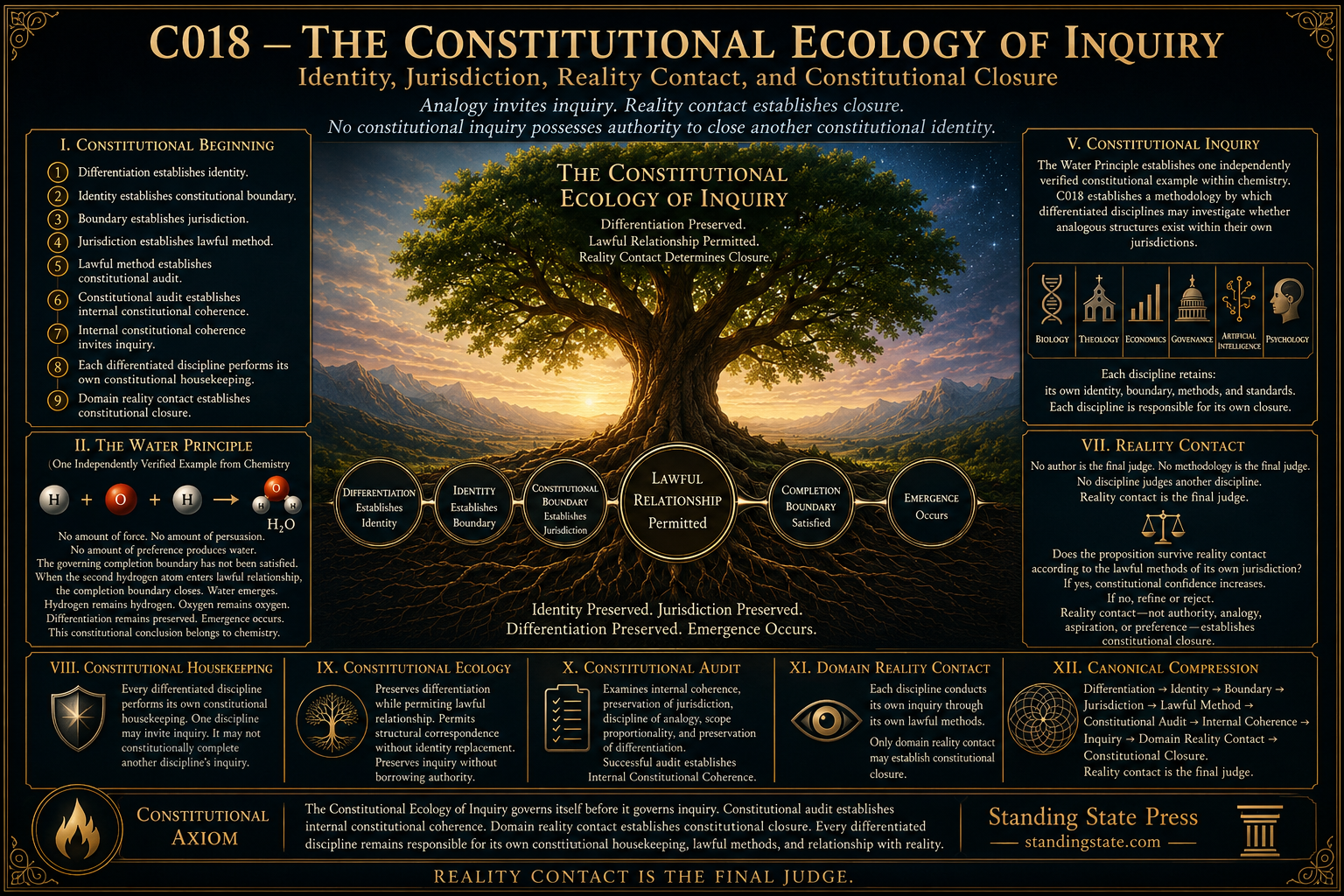
Every discipline eventually encounters the same constitutional question.
Not: Can a conclusion be asserted?
Rather: How is constitutional closure lawfully established?
C018 does not propose a universal law governing every discipline.
Instead, it establishes a constitutional methodology through which differentiated disciplines may investigate possible structural correspondences while preserving their own identities, jurisdictions, lawful methods, and standards of verification.
One independently verified example from chemistry establishes a constitutional completion boundary within its own jurisdiction. Whether analogous structures recur elsewhere remains the constitutional responsibility of those disciplines themselves.
No constitutional inquiry possesses authority to close another.
Reality contact is the final judge.
Every coherent inquiry begins with differentiation.
Differentiation establishes identity.
Identity establishes constitutional boundary.
Boundary establishes jurisdiction.
Jurisdiction establishes lawful method.
Lawful method establishes constitutional audit.
Constitutional audit establishes internal constitutional coherence.
Internal constitutional coherence invites inquiry.
Each differentiated discipline performs its own constitutional housekeeping.
Domain reality contact establishes constitutional closure.
This sequence constitutes the constitutional ecology of inquiry.
Consider one independently verified example from chemistry.
Suppose there exists: one hydrogen atom, one oxygen atom.
No amount of force produces water.
No amount of persuasion produces water.
No amount of preference produces water.
The governing completion boundary has not been satisfied. The lawful relationship required for water does not yet exist.
When the second hydrogen atom enters lawful relationship, the completion boundary closes. Water emerges. Hydrogen remains hydrogen. Oxygen remains oxygen. Differentiation remains preserved. Emergence occurs.
This constitutional conclusion belongs to chemistry. It does not constitutionally establish conclusions for any other discipline.
Water emerges because differentiated identities remain themselves while entering lawful relationship. Identity is preserved. Jurisdiction is preserved. Differentiation is preserved.
Emergence therefore occurs through constitutional completion rather than constitutional collapse.
This observation remains consistent with C016 — The Syntheos Effect: coherence emerges through lawful relationship while differentiated identities retain constitutional integrity.
Presence alone is insufficient. Proximity alone is insufficient. Capability alone is insufficient. Completion requires satisfaction of the governing boundary.
Completion is not negotiated. Completion is verified.
The Water Principle establishes one independently verified constitutional example within chemistry. C018 does not declare that identical completion boundaries govern every discipline. Instead, it establishes a constitutional methodology by which differentiated disciplines may investigate whether analogous structures exist within their own jurisdictions.
Illustrative domains include:
Biology
Theology
Economics
Governance
Artificial Intelligence
Psychology
Each discipline retains:
its own constitutional identity,
its own constitutional boundary,
its own lawful methods,
its own standards of verification,
its own constitutional responsibility for closure.
Analogy invites inquiry. Reality contact establishes closure.
Every differentiated constitutional identity possesses its own boundary.
Chemistry remains chemistry.
Biology remains biology.
Theology remains theology.
Economics remains economics.
Engineering remains engineering.
Artificial Intelligence remains Artificial Intelligence.
Relationship remains constitutionally admissible. Boundary collapse does not. Differentiation preserves constitutional integrity.
No author is the final judge.
No methodology is the final judge.
No discipline judges another discipline.
Reality contact is the final judge.
Every constitutional proposition ultimately reaches one question: does it survive reality contact according to the lawful methods of its own jurisdiction?
If reality contact confirms the proposition, constitutional confidence increases. If reality contact contradicts the proposition, the proposition must be refined, or rejected.
Reality contact — not authority, analogy, aspiration, or preference — establishes constitutional closure.
Every differentiated discipline performs its own constitutional housekeeping.
One discipline may invite inquiry. It may not constitutionally complete another discipline's inquiry.
Constitutional housekeeping preserves:
identity,
jurisdiction,
lawful method,
constitutional integrity.
Closure remains the responsibility of the participating discipline.
The Constitutional Ecology of Inquiry preserves differentiation while permitting lawful relationship. It does not unify disciplines through constitutional collapse. It permits structural correspondence without identity replacement. It preserves inquiry without borrowing constitutional authority.
Each differentiated discipline develops within its own constitutional basin through its own lawful methods. Reality contact determines whether proposed correspondences endure.
Before inviting any differentiated discipline into inquiry, the methodology must first govern itself.
Constitutional audit examines:
internal coherence,
preservation of jurisdiction,
constitutional discipline of analogy,
proportionality of scope,
preservation of differentiation.
Successful constitutional audit establishes: Internal Constitutional Coherence.
It does not establish disciplinary truth.
Following constitutional audit, each differentiated discipline conducts its own inquiry.
Chemistry performs chemical verification.
Biology performs biological verification.
Economics performs economic verification.
Engineering performs engineering verification.
Artificial Intelligence performs AI verification.
Theology performs theological inquiry according to its own constitutional methods.
Each discipline performs its own constitutional housekeeping.
Only domain reality contact may establish constitutional closure.
Differentiation establishes identity.
Identity establishes constitutional boundary.
Boundary establishes jurisdiction.
Jurisdiction establishes lawful method.
Lawful method establishes constitutional audit.
Constitutional audit establishes internal constitutional coherence.
Internal constitutional coherence invites inquiry.
Each differentiated discipline performs its own constitutional housekeeping.
Domain reality contact establishes constitutional closure.
Reality contact is the final judge.
No constitutional inquiry closes another constitutional identity.
The Constitutional Ecology of Inquiry governs itself before it governs inquiry. Constitutional audit establishes internal constitutional coherence. Domain reality contact establishes constitutional closure.
Every differentiated discipline remains responsible for its own constitutional housekeeping, lawful methods, and relationship with reality.
Analogy invites inquiry. Reality contact establishes closure. No constitutional inquiry possesses authority to close another constitutional identity.
Canonical ID: C018
Title: The Constitutional Ecology of Inquiry: Identity, Jurisdiction, Reality Contact, and Constitutional Closure
Classification: Canonical Methodology · Final
Relationship to Corpus:
C016 — Establishes differentiated constitutional identities and jurisdictions.
C017 — Establishes constitutional inquiry as an open, discipline-preserving process.
C018 — Establishes the methodology by which constitutional inquiry proceeds without borrowing another discipline's authority, distinguishing constitutional audit (internal coherence) from domain reality contact (discipline-specific closure).