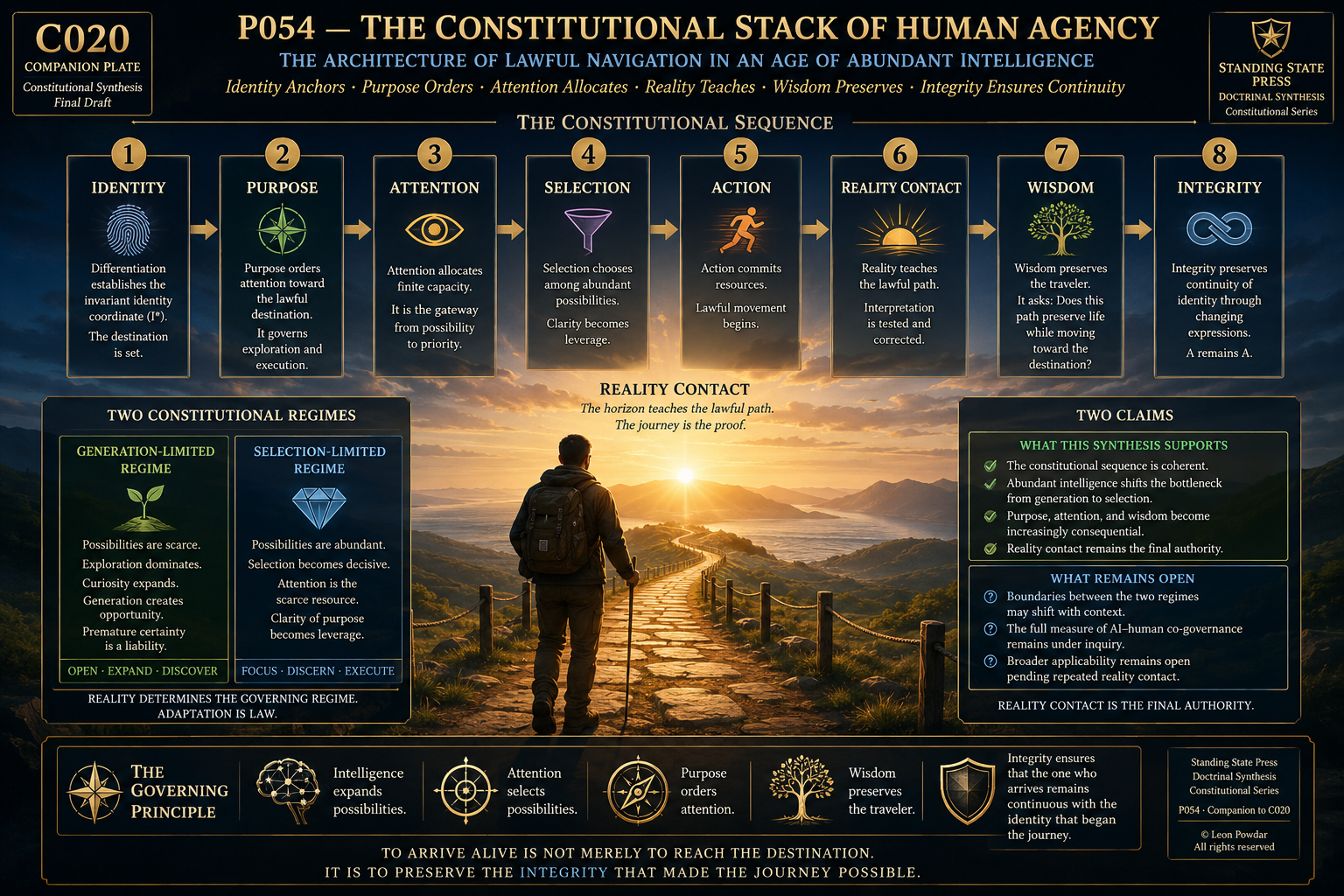
Throughout history, intelligence has often been treated as the scarce resource. Knowledge was difficult to obtain. Information was expensive to preserve. Expertise was limited by access.
The emergence of artificial intelligence alters this constitutional landscape.
Generation increasingly becomes abundant.
The constitutional bottleneck shifts.
The central question is no longer:
Can possibilities be generated?
Rather:
Which possibilities should be pursued?
This essay argues that abundant intelligence increases the constitutional importance of differentiation, purpose, attention, wisdom, and integrity.
Intelligence expands possibilities.
Attention selects possibilities.
Purpose orders attention.
Wisdom preserves the traveler.
Integrity ensures that the identity which arrives remains continuous with the identity that began the journey.
This essay advances a constitutional synthesis. It does not claim universal doctrine. It presents a bounded framework whose continued maturation remains subject to reality contact.
Every age possesses a constitutional scarcity.
Agricultural civilizations were constrained by food.
Industrial civilizations were constrained by production.
Information civilizations were constrained by access to knowledge.
Artificial intelligence changes the scarcity.
Possibilities become abundant.
Selection becomes scarce.
The constitutional center of gravity therefore moves from generation toward governance.
The question becomes not:
Can intelligence produce another answer?
but:
Which answer deserves attention?
Navigation begins before movement.
Every lawful journey begins by differentiating its destination.
Without a differentiated destination, every path appears equally reasonable.
More intelligence merely generates more routes.
No amount of computation compensates for an undefined destination.
Purpose therefore precedes optimization.
Differentiation precedes navigation.
The first constitutional question becomes:
What exactly am I trying to reach?
Artificial intelligence can generate thousands of alternatives.
Human attention cannot pursue thousands simultaneously.
Attention therefore becomes the constitutional allocation mechanism.
Intelligence proposes.
Attention selects.
Selection determines trajectory.
The limiting resource is no longer possibility.
The limiting resource becomes the lawful allocation of finite attention.
Attention without purpose fragments.
Purpose without attention remains unrealized.
Purpose provides orientation.
Attention provides allocation.
Together they transform possibility into trajectory.
Purpose does not eliminate exploration.
Purpose governs exploration.
Exploration itself possesses lawful purpose: to discover what has not yet been differentiated.
Execution possesses lawful purpose: to develop what has already been differentiated.
Purpose therefore possesses multiple constitutional modes while remaining one office.
The relationship between intelligence and purpose depends upon constitutional scarcity.
Generation-Limited Regime — When possibilities themselves remain scarce: exploration dominates, curiosity expands, generation creates opportunity. Premature certainty becomes a liability. The traveler benefits by remaining open.
Selection-Limited Regime — When possibilities become abundant: generation becomes inexpensive, selection becomes decisive, attention becomes increasingly valuable. Clarity of purpose becomes leverage.
These are not competing doctrines.
Reality determines which constitutional regime presently governs.
Purpose does not determine reality.
Reality determines whether purpose is lawfully pursued.
Interpretation proposes.
Reality disposes.
Every route remains subject to correction.
A lawful traveler remains teachable.
Reality therefore preserves navigation from becoming ideology.
Wisdom is neither information nor intelligence.
Wisdom governs movement through reality while preserving continuity.
One may possess enormous intelligence while traveling toward destruction.
One may possess modest intelligence while arriving safely.
Wisdom therefore asks a different constitutional question:
Does this path preserve life while moving toward its lawful destination?
Wisdom preserves the traveler.
Development does not preserve an unchanged traveler.
Development preserves the invariant identity through changing expressions.
Identity remains.
Understanding matures.
Interpretation improves.
Behavior develops.
Integrity preserves constitutional continuity throughout that maturation.
The destination is not sameness.
The destination is lawful continuity.
The architecture may be summarized as follows:
Differentiation identifies the destination.
Purpose orders attention.
Attention allocates finite resources.
Intelligence generates lawful possibilities.
Reality Contact distinguishes viable routes.
Wisdom preserves life throughout the journey.
Integrity preserves continuity of identity across development.
Each office possesses its own jurisdiction.
None replaces another.
None governs outside its office.
Their coherence emerges through lawful relationship.
This synthesis does not claim universal application.
Its central claim applies specifically to constitutional environments where generation has become relatively abundant and selection has become the primary scarcity.
Where generation remains scarce, exploration may properly dominate.
Where selection becomes scarce, clarity becomes leverage.
Reality determines the governing regime.
The framework remains open to correction whenever reality demonstrates otherwise. Broader applicability remains open pending repeated reality contact.
This synthesis follows the constitutional discipline established elsewhere within the corpus.
Differentiation authorizes inquiry.
Reality contact authorizes doctrine.
Every synthesis remains bounded by the fidelity of the reality contact it has survived.
Future inquiry may strengthen, refine, or reopen any claim whenever higher-fidelity reality contact requires it.
Development proceeds through lawful continuity rather than exemption from correction.
Artificial intelligence changes neither reality nor identity.
It changes the constitutional economics of inquiry.
As possibilities multiply, the lawful ordering of attention becomes increasingly consequential.
Purpose differentiates the destination.
Attention allocates finite capacity.
Intelligence expands lawful possibilities.
Reality teaches.
Wisdom preserves the traveler.
Integrity preserves the invariant identity through changing expressions.
The future advantage is not unlimited intelligence.
The future advantage is the constitutional discipline to choose wisely among abundant possibilities while preserving the one who journeys.
To arrive alive is not merely to reach the destination.
It is to preserve the integrity that made the journey possible.
Intelligence expands possibilities.
Attention selects possibilities.
Purpose orders attention.
Reality teaches the lawful path.
Wisdom preserves the traveler.
Integrity preserves the invariant identity through changing expressions.
Development emerges through lawful relationship.
A becomes A, because A knows it is A.
Canonical ID: C020
Title: The Constitutional Economy of Intelligence: Purpose, Selection, and the Lawful Preservation of the Traveler
Classification: Canonical Synthesis · Final Draft
Author: Leon Powdar · ORCID: 0009-0004-1026-4357
Relationship to Corpus:
C017 — Establishes the I* Guardian. Admissibility before consequence.
C018 — Establishes the Constitutional Ecology of Inquiry. Reality contact establishes closure.
C019 — Establishes lawful relationship among independently completed inquiries.
C020 — Establishes the constitutional economy of intelligence: as generation becomes abundant, selection becomes the governing scarcity. Candidate synthesis. Validation deferred.
Constitutional status at registration: C020 is a candidate constitutional synthesis. It does not claim universal doctrine. Broader applicability remains open pending repeated reality contact. Reality contact remains the final judge.